
K-Factor in Sheet Metal: Flat Pattern Calculation
A bent part starts life as a flat blank, and the length of that blank is not the sum of the outside dimensions. The material in the bend neither stretches nor compresses along one specific line, and finding that line is what the K-factor does. Get it wrong and every part is short or long by the accumulated error in its bends.
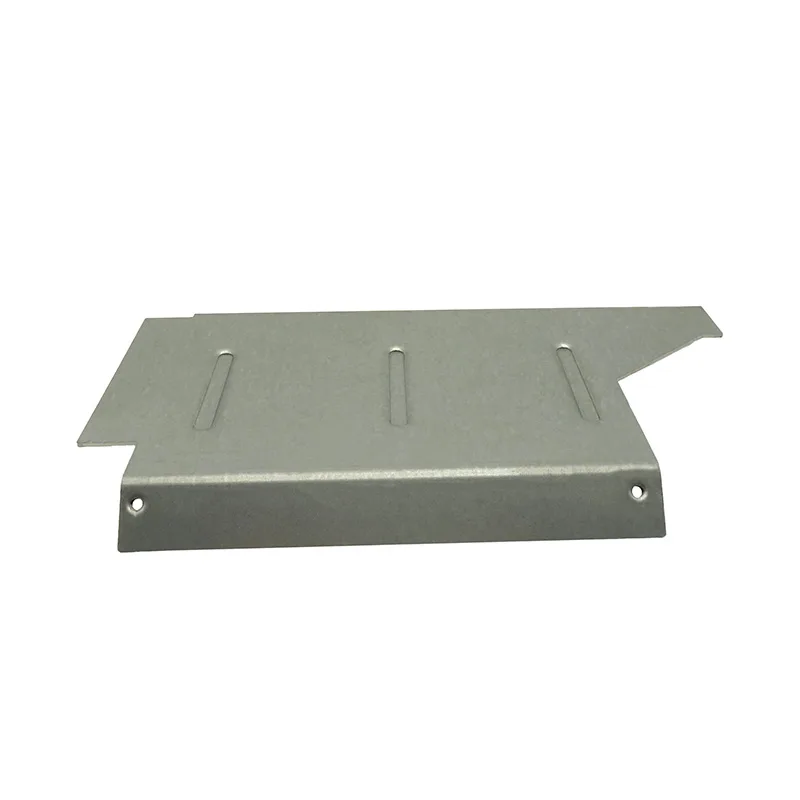
The K-factor is the ratio of the neutral axis position to the material thickness — the number that tells you how far through the sheet the bend neither stretches nor compresses. It is what makes a flat pattern the right length, and typical values sit around 0.33 to 0.45 for air bending.
01Why you cannot simply add up the flat lengths
The naive approach is to sum the flat legs between bends and ignore the bend itself. It fails because the material in the bend has to come from somewhere: the outside surface stretches, the inside compresses, and neither dimension is the length the blank needs. The real length lies somewhere between them.
Where exactly is what the K-factor expresses. It gives the position of the neutral axis as a fraction of the thickness, measured from the inside surface. A K-factor of 0.4 on 2 mm sheet means the neutral axis sits 0.8 mm from the inside face, and the blank length is computed along that line rather than along either surface.
02Bend allowance and bend deduction
Two conventions express the same geometry, and mixing them is the most common source of flat-pattern error. The bend allowance is the arc length of the neutral axis through the bend, and it is added to the flat legs. The bend deduction is the amount by which the sum of the outside dimensions exceeds the blank, and it is subtracted from them.
Both derive from the same K-factor, the radius and the angle. A CAD system will use one or the other internally, and a supplier's press brake controller may use the other. When the two are mixed, the discrepancy is small per bend and multiplies quickly — which is why the convention should be stated on the drawing or in the flat-pattern data.
03Typical K-factor values
| Process / condition | Typical K-factor | Why it sits there |
|---|---|---|
| Air bending, R/t between 1 and 2 | 0.33 – 0.40 | The die opening controls the radius; the neutral axis moves with R/t |
| Air bending, R/t above 2 | 0.40 – 0.45 | A generous radius lets the neutral axis approach mid-thickness |
| Bottom bending / coining | 0.42 – 0.48 | The material is pressed into the die and thins at the bend |
| Very tight radius | 0.25 – 0.33 | High strain moves the neutral axis toward the inside surface |
| Roll forming / large radii | Approaching 0.5 | Large radius relative to thickness approaches pure bending |
Indicative K-factor ranges by process (confirm against your own tooling and material)
04Where the value comes from and how to verify it
K-factor is not a constant property of a material like density. It depends on the radius-to-thickness ratio, the forming method, the tooling geometry and the temper. Published tables are a starting point, not a specification.
The reliable way to establish a value for your own parts is empirical: cut a blank of known length, form it on the intended tooling, measure the result, and back-calculate. A shop that runs the same material and tooling daily will have arrived at values this way, and those are the numbers worth putting in the flat pattern.
For a single part or a prototype, a conservative starting value with a dimensional check on the first article is usually enough. For a production programme, arriving at the value once and locking the flat pattern is cheaper than discovering the drift across a thousand parts.
05What this means in practice
- State the radius convention and the K-factor or bend-deduction table your flat pattern was built from; do not leave it implicit.
- Use the value matching your actual forming method — an air-bend figure will be wrong for a coined bend.
- Expect the value to shift with the radius-to-thickness ratio; a single global K-factor across a part with mixed radii introduces error.
- For a production run, confirm the first article dimensionally before committing the balance of the batch.
- Where the part has many bends, check the accumulated tolerance rather than each bend in isolation.
Frequently asked questions
What is a K-factor in sheet metal?
It is the ratio of the neutral axis distance from the inside surface to the material thickness. That single number locates the line through the bend that neither stretches nor compresses, and therefore determines the correct flat blank length.
What is a typical K-factor value?
For air bending, roughly 0.33 to 0.45 depending on the radius-to-thickness ratio, with higher values for generous radii. Tight radii and coining push it in different directions, so treat any single figure as a starting point and verify it against your tooling.
Is K-factor the same as bend allowance?
No. The K-factor is the input that locates the neutral axis; the bend allowance is the resulting arc length through the bend, and the bend deduction is the equivalent expressed as an amount to subtract from the outside dimensions. Both are derived from the K-factor.
Does the K-factor change with material?
It varies more with forming method and the radius-to-thickness ratio than with the alloy, but material properties do matter, particularly where the material thins at the bend. Use values established on your own material and tooling for anything going into production.
How do I check a flat pattern is correct?
Form the first part and measure it. If the blank is consistently short or long across all bends, the K-factor is wrong; if a single bend is out, the radius assumption on that feature is wrong. Either way the correction is in the flat-pattern data, not in the press brake.
Send the drawing, get a real answer
An engineer reviews your model for manufacturability and returns a costed quotation — with the DFM observations that would change the price.