
Sheet Metal Hole Design: Sizes and Bend Clearance
Holes look like the least interesting feature on a sheet metal part, and they cause a disproportionate share of the scrap. Almost all of it comes down to three clearances, and all three are checkable in a few minutes on the drawing.
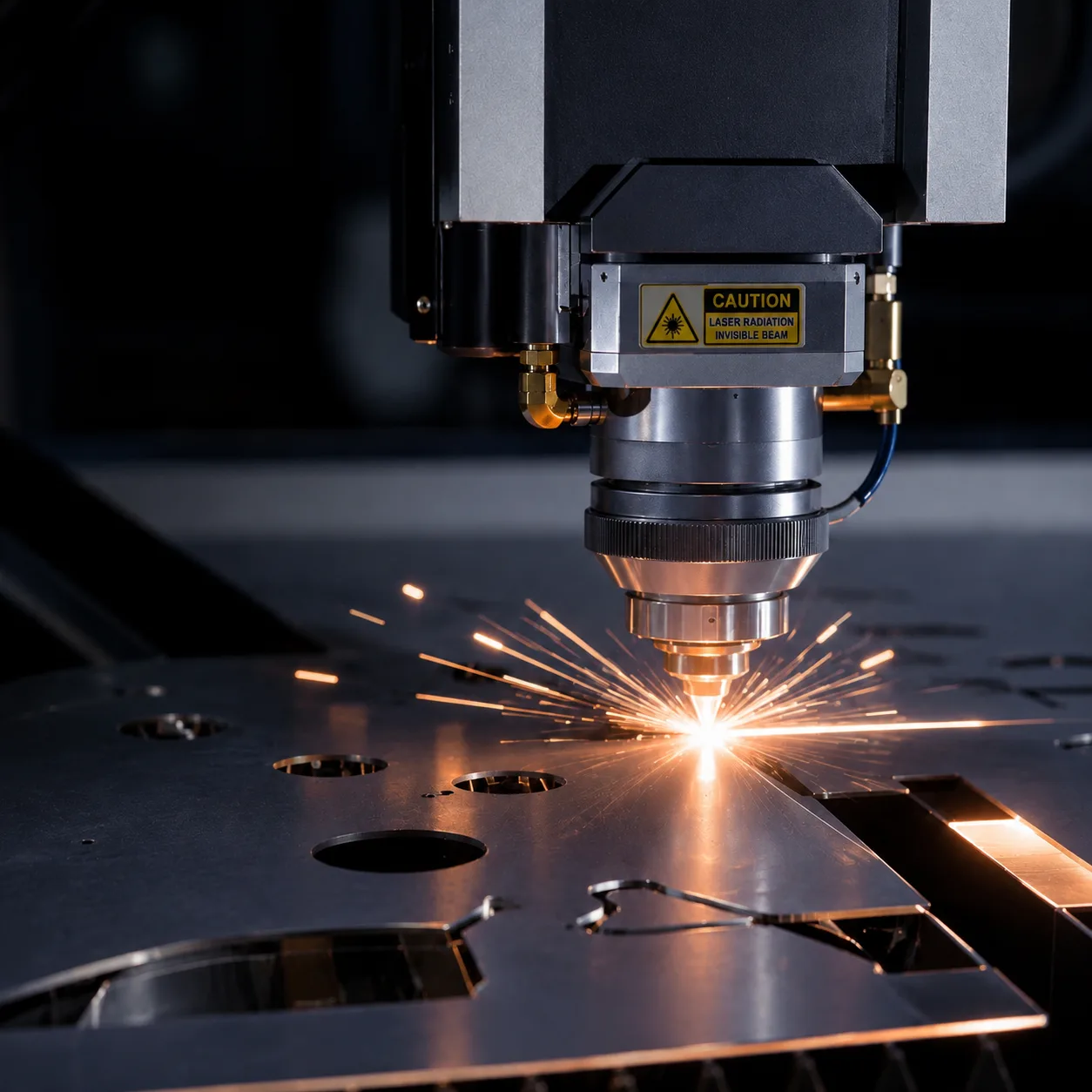
Holes and slots are where sheet metal design fails quietly. The three numbers that matter are the minimum size (about the material thickness), the distance to a bend line (2.5 × thickness plus the inside radius), and the distance to an edge (about one thickness).
Minimum hole and slot size
A laser kerf is narrow but not zero, and the beam is round, so a hole is limited by what the process can pierce and clear rather than by what it can outline. As a working rule, holes at or above the material thickness cut cleanly and repeatably; below that, quality falls off and the better route is drilling or punching.
Slots behave the same way on the narrow dimension. A slot 0.8 mm wide in 1.5 mm material is a different job from a rectangular cut-out: it needs a pierce at each end and the molten material has to clear, which limits how narrow it can go.
Distance to a bend, and why holes move
Bending stretches material on the outside of the bend and compresses it on the inside. A hole inside that deformation zone will not stay round, and it will not stay in position. The working rule is to keep the hole at least 2.5 times the thickness plus the inside bend radius away from the bend line, measured on the outside of the bend.
Where the position is fixed by function and that clearance is not available, a relief notch or slot at the bend line gives the deformation somewhere to go. It is one more cut and it is far cheaper than a distorted hole discovered at first article.
| Feature | Rule of thumb | What happens if you ignore it |
|---|---|---|
| Hole diameter | ≥ material thickness | Laser quality drops; punching needs fragile tooling |
| Slot width | ≥ material thickness | Poor cut quality; dross; tooling wear |
| Hole to bend line | ≥ 2.5 × t + inside radius | Hole distorts and shifts |
| Hole to edge | ≥ 1 × t | Web tears during forming, handling or bolting |
| Hole to hole web | ≥ 1 × t | Web between holes deforms under clamp load |
| Internal corner radius | ≥ 0.5 × t | Laser cannot produce a sharp corner; the corner burns or needs a second operation |
| Tapped hole | Thickness ≥ pitch diameter or use an insert | Thread strips at the first assembly |
Clearances worth checking on every drawing
Designing for the fastener, not just the hole
A clearance hole is not the same as a location hole. Where a joint has to be repeatable, one hole should be sized to locate — a clearance fit that is close, or a slot in a single direction — and the rest should be plain clearance. Making every hole a location hole turns a straightforward assembly into a stack-tolerance problem.
Where the fastener needs more material than the sheet provides — a thread, a shear load, a high clamp load — the answer is a self-clinching insert, a welded nut or a doubler plate. Each one has its own thickness and edge-distance rules, and each changes the hole size, so deciding late means re-cutting the part.
- Size one hole to locate, the rest to clear. Say which is which.
- Where a bolt head or washer bears on the sheet, check the bearing diameter against the hole size.
- Countersunk heads need depth control — confirm the panel thickness is enough to take the head.
- Add a relief when the hole-to-bend distance cannot be met.
- Where a hole must be a thread, decide between thread-forming, an insert and a welded nut at design stage.
Frequently asked questions
What is the minimum hole size you can laser cut?
Rule of thumb is the material thickness. In 2 mm steel a 2 mm hole cuts reliably; a 1 mm hole is possible but quality and repeatability drop, and the better answer is usually to drill it or to change the design. Slots have the same limit on their narrow dimension.
How close can a hole be to a bend?
At least 2.5 times the material thickness plus the inside bend radius from the bend line on the outside of the bend. Closer than that the material around the hole is being stretched, so the hole goes oval and drifts. If the position is fixed, add a relief notch at the bend line.
Why does my hole come out slightly small?
Usually one of three things: kerf compensation, a coating that adds thickness inside the hole, or tapping allowance. Powder coating narrows a cut-out by roughly 0.12–0.24 mm overall. Where a hole carries a tight tolerance, tell us whether it is measured before or after coating.
Can you cut a square hole with sharp corners?
Not with a laser. The beam is round, so every internal corner takes a radius of at least about half the kerf. A sharp internal corner needs a secondary operation — usually a mill or a broach — which is materially more expensive than a small radius you would not notice.
How many holes before a part should be punched instead of lasered?
When the total cut length and pierce count start to dominate the cost. A perforated panel with hundreds of holes is often faster punched than lasered, and a repeated pattern at high volume is a candidate for a die. We will compare routes on your part rather than on a general rule.
Send the drawing, get a real answer
An engineer reviews your model for manufacturability and returns a costed quotation — with the DFM observations that would change the price.