
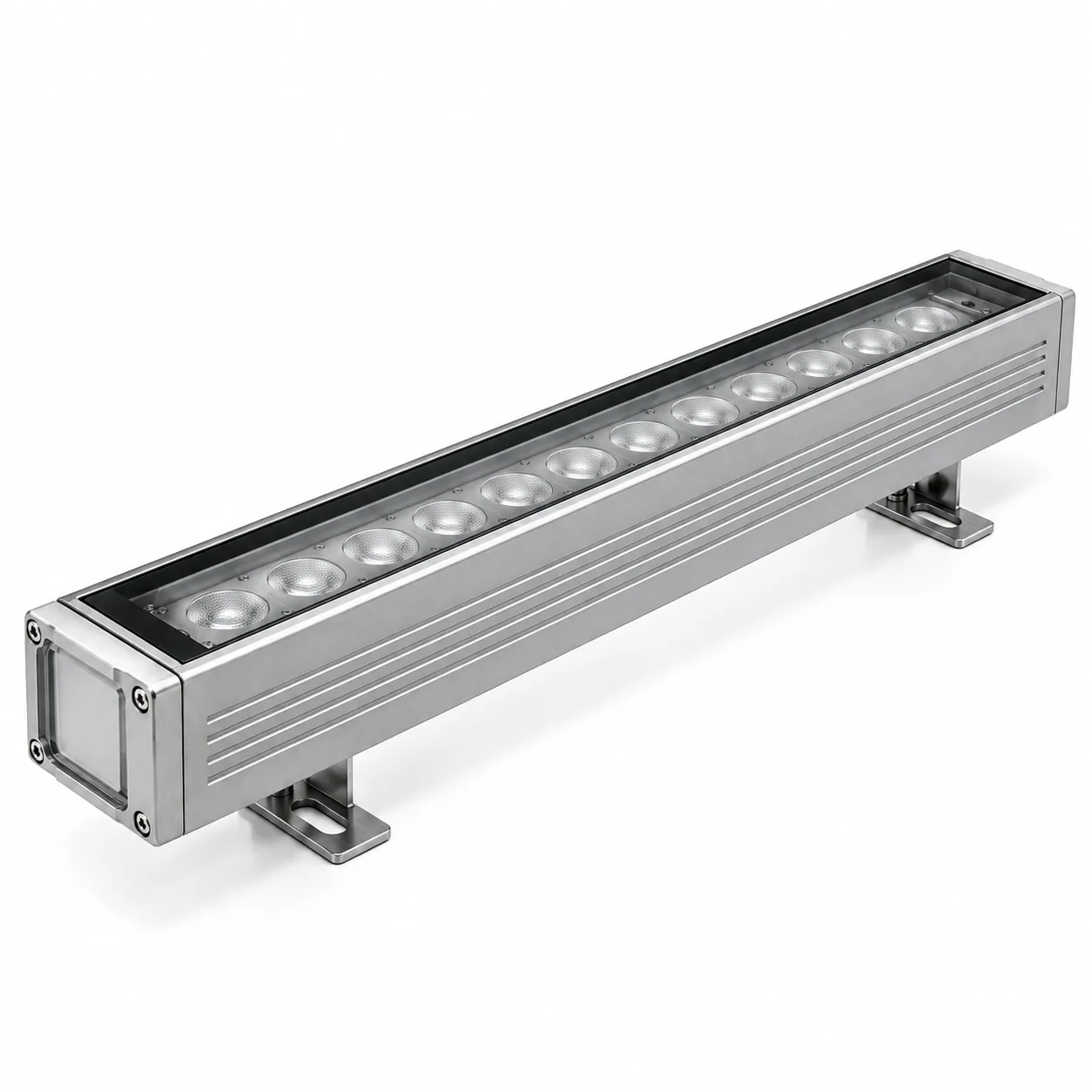
The part
Material: 5052 aluminium at 2 mm, selected for thermal conductivity, weather resistance and anodising compatibility. A housing roughly 600 × 120 × 60 mm with a flat internal mounting face for the LED board, an anodised external surface, and a gasketed lens frame.
The thermal requirement was the binding constraint: the board mounting face had to be flat and in continuous contact, because an air gap between the board and the housing is a thermal barrier that no amount of external surface area compensates for.
The thermal path
The product designer would not accept conventional finning, so the external area came from a shallow embossed rib pattern formed into the face. Embossed ribs add area and stiffness at the same time, and they read as a design feature rather than a heat sink, which was the requirement.
| Stage | Requirement | How it was met |
|---|---|---|
| LED board to housing | Continuous contact, no air gap | Flatness callout on the mounting face; thermal interface material specified by the customer |
| Through the housing wall | Short path in a conductive material | Board mounts to the main formed face, not to a bracket |
| Housing to ambient | Surface area plus emissivity | Embossed rib pattern on the external face increasing area without tall fins |
| Exterior finish | Emissivity without corrosion | Anodised rather than painted; clear anodising keeps the metallic appearance |
Forming, anodising and masking
Anodising grows the oxide out of the aluminium, so it moves the surface by roughly half the coating thickness per side. On a housing where the board mounting face has a flatness requirement, that growth matters, and it was accounted for by masking the mounting face so it stays bare and dimensionally stable.
Masking also protects the earth connection and the gasket land, both of which need bare metal for function. As with all masked parts, the drawing defines the areas rather than leaving it to the finishing stage.
Inspection
The mounting face flatness was measured on the first article, because it is the feature the thermal performance depends on, and coating thickness was checked on the anodised faces including the rib pattern, where coverage is easy to lose in the recesses.
The masked areas were verified as bare aluminium. An anodised mounting face would look correct and would add a thermally resistive layer exactly where the design needed contact, so this is a check worth making explicitly.
What transfers
- On a heat-dissipating enclosure, the internal contact face is the critical feature, not the external surface area.
- Embossed ribs add area and stiffness at once, and they can be styled as a feature rather than reading as a heat sink.
- Anodising moves surfaces. Mask anything with a dimensional or electrical function.
- Anodise aluminium that has to radiate; a paint film over the same surface reduces its emissivity.