
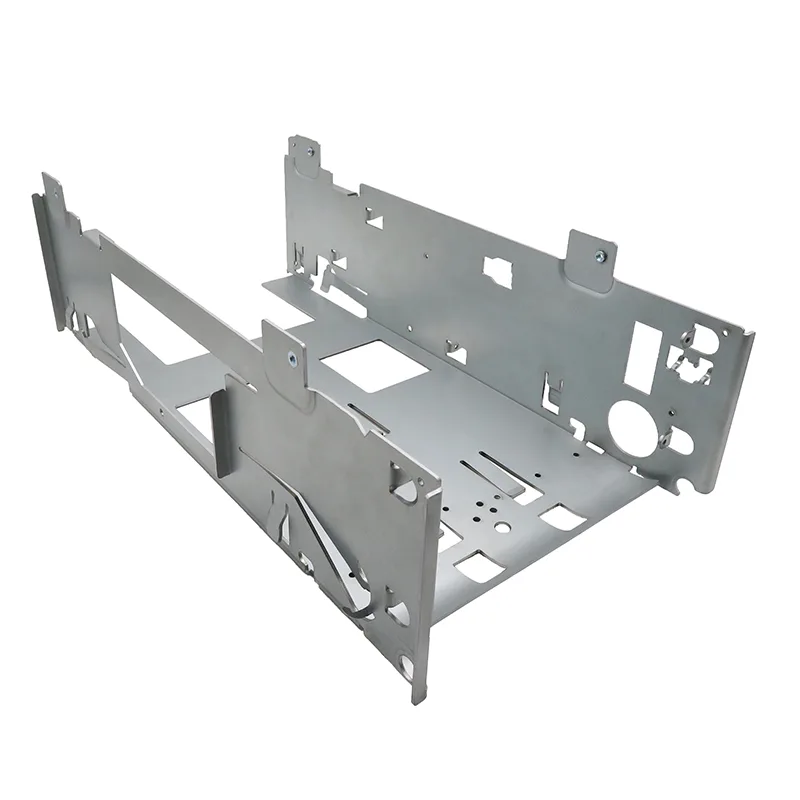
The part
Material: SECC electro-galvanised steel at 1.2 mm, chosen because the internal faces stay protected by the zinc while the external face takes a powder coat. Roughly 500 × 400 mm, with cut-outs for a display, a card reader bezel, a keypad and a receipt slot.
The positional requirements were tighter than general tolerance on the three functional cut-outs, because each interfaces with a bought-in module with its own mounting flange. The cosmetic requirement was class A over the entire external face.
Why positional tolerance came from the datum, not the edge
Dimensioning the cut-outs from the panel edge makes their position depend on the sheared and formed condition of that edge, which varies. Dimensioning them from a pierced datum hole makes them independent of the edge, and it gives inspection a single unambiguous reference.
The same datum then locates the module mounting studs on the inside face, so the relationship between the cut-out and the studs is held directly rather than through the panel's outer geometry. On a kiosk where three separate modules have to line up with one face, that relationship is the whole requirement.
Protecting the cosmetic face during manufacture
The stiffening return around the display aperture is worth noting because it is a functional addition with a cosmetic benefit: a large opening removes the stiffness from the middle of the panel, and the return restores it while also giving the aperture a defined edge for the module bezel to sit against.
| Risk | Measure |
|---|---|
| Scratches from handling and nesting | Protective film applied at the laser stage and left on through forming |
| Die witness marks | Urethane-protected punch; dedicated die set for the visible bends |
| Burrs on cut-out edges | Deburr before coating; a raised burr shows through a film finish |
| Distortion near large cut-outs | Add a formed stiffening return around the display aperture |
| Silk-screen misregistration | Print after forming, located from the same pierced datum as the cut-outs |
Inspection
Inspection followed the datum: cut-out positions and module stud positions measured from the pierced datum, aperture dimensions checked against the module drawings, and appearance assessed against the agreed class under a defined light source.
Silk-screened legends were checked for position and, separately, for adhesion, because legend wear is the failure the public notices first on a kiosk panel. That is a finish check rather than a dimensional one, and it belongs in the inspection plan from the first article.
What transfers
- Dimension functional cut-outs from a pierced datum, never from an edge that gets sheared and formed.
- Locate everything from one datum — cut-outs, studs and printing — so their relationship is held directly.
- Protect cosmetic faces from the first cutting operation, not from the finishing stage.
- Use formed returns around large apertures; they restore stiffness and give the module a defined seat.