
Application

Metal Stamping for Automotive: Brackets & Parts

Automotive parts are unglamorous and unforgiving: a bracket that costs almost nothing has to be identical in the ten-thousandth year of production. Most of the engineering is about removing variability rather than removing cost.

Reviewed by Tom, Senior Process Engineer·Dongguan source factory · 11+ years in precision sheet metal
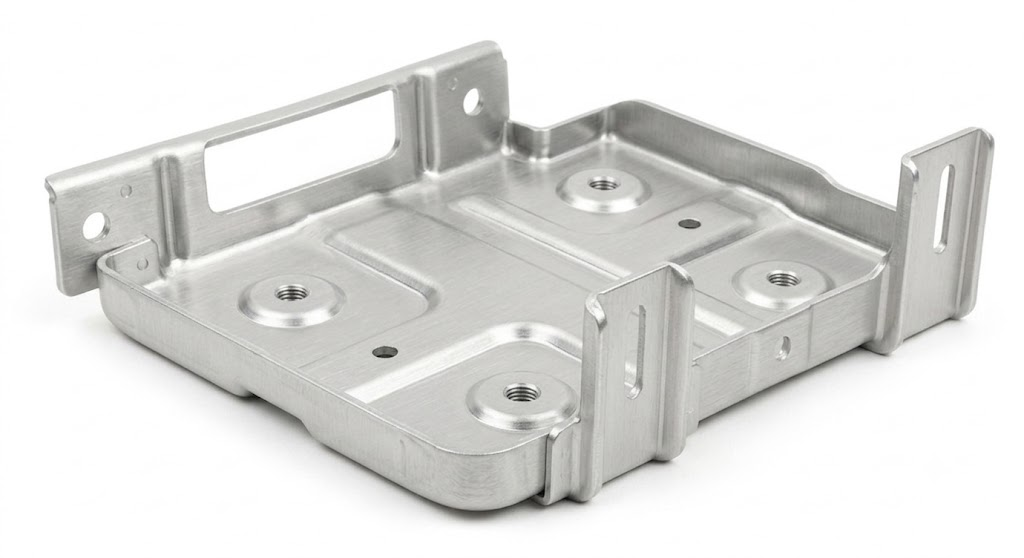
automotive stamped bracket zinc — metal stamping for automotive
Short answer

Automotive stamping work is defined by volume, documentation and repeatability. High annual volumes justify progressive tooling, the sector expects a documented inspection plan and material traceability, and repeatability matters more than either because the parts run for years.

Why the process is usually stamping

At automotive volumes, per-part cost is dominated by cycle time and handling. A progressive die delivers a finished part per stroke with the deburr moved to a batch tumble, so the labour content of the part approaches zero. Laser cutting and bending is used for prototype and early production, then the part moves to a die once the design is frozen.

What can go wrong is tooling a design that is not final. The strip layout cannot be revised economically — station sequence, progression pitch and material width are built into the die blocks and the feed — so a late engineering change to a stamped part is a die modification or a new die.

Material and feature notes for this sector

PointWhy it matters here
High-strength and HSLA steelsForming stations do more work per stroke; strip design must carry the part longer
Burr directionSet by punch-die clearance and must face away from mating surfaces and hands
Bend reliefEssential wherever a bend runs to the edge; tears are a warranty issue, not a scrap issue
Minimum pierce sizeA fragile punch in a die running millions of cycles is a maintenance cost forever
Coating and platingZinc-nickel and similar coatings change the thread and the fit; allowance is a drawing decision
SpringbackHigher-strength material springs back more; the form station is designed for the material, not for a nominal angle
Design points that come up repeatedly

Documentation: what we provide, and what we do not hold

Automotive customers typically ask for a first article dimensional report against the ballooned drawing, a material certificate, an inspection plan with defined sampling, and a tool record covering the die and any try-out adjustments. Those we provide as a matter of course.

What we do not hold is IATF 16949, and we do not claim it. Where a programme requires a certified quality management system, that requirement has to be met by a supplier who holds the certificate; we would rather say that at enquiry stage than discover it after tooling has been cut. Where the requirement is a documented, repeatable inspection process and traceability, that is what we already do.

  • Send the annual volume and the expected programme life — both drive the tooling decision.
  • Freeze the design before the die is cut; the strip layout is the irreversible part.
  • State the edge condition where it is functional: a thread, a sealing face, a sliding fit.
  • Say which documentation set your quality team needs, at enquiry stage.

Frequently asked questions

Do you hold IATF 16949?

No, and we will not imply otherwise. We can provide a first article dimensional report, material certificates and a documented inspection plan, and we run the process to a defined method. Where a certified automotive QMS is a hard requirement, that is a supplier-selection criterion and should be settled before tooling is ordered.

What volumes justify a progressive die?

It is a payback calculation, not a threshold: die cost divided by the per-part saving against laser cutting and bending. A bracket with several pierced holes and formed features pays back far sooner than a plain plate. Send the drawing and an annual volume and we will run it.

Can you run a part that is still being revised?

On the laser route, yes — a revision is a programme edit. On a die, no: changes that move the strip layout require the die to be rebuilt, and even an added station is a die modification. That is the practical reason the design freeze comes before tooling.

How is the burr direction controlled?

By punch-die clearance, which is set when the die is made and maintained through its life. The burr appears on the die side, so it is fixed at die design; where it must face a particular way in the assembly, that has to be on the drawing.

Do you handle the coating and plating as well?

Yes, as a process route within the same order — stamping, tumble deburr, plating, packing. Keeping it together matters on automotive parts because the coating is dimensional: it changes thread fits and clearance, so the allowance belongs in the drawing rather than in a later adjustment.

Send the drawing, get a real answer

An engineer reviews your model for manufacturability and returns a costed quotation — with the DFM observations that would change the price.