What is sheet metal fabrication, and what does WERIX actually do?
Sheet metal fabrication turns flat stock — steel, stainless, aluminium, copper or brass — into a finished part through a fixed chain of operations: cut the blank, form it, join it, finish it, inspect it. Which machines run that chain depends on the geometry and the quantity, and the whole job of an engineering-led factory is choosing the shortest route that holds tolerance at the volume you need.
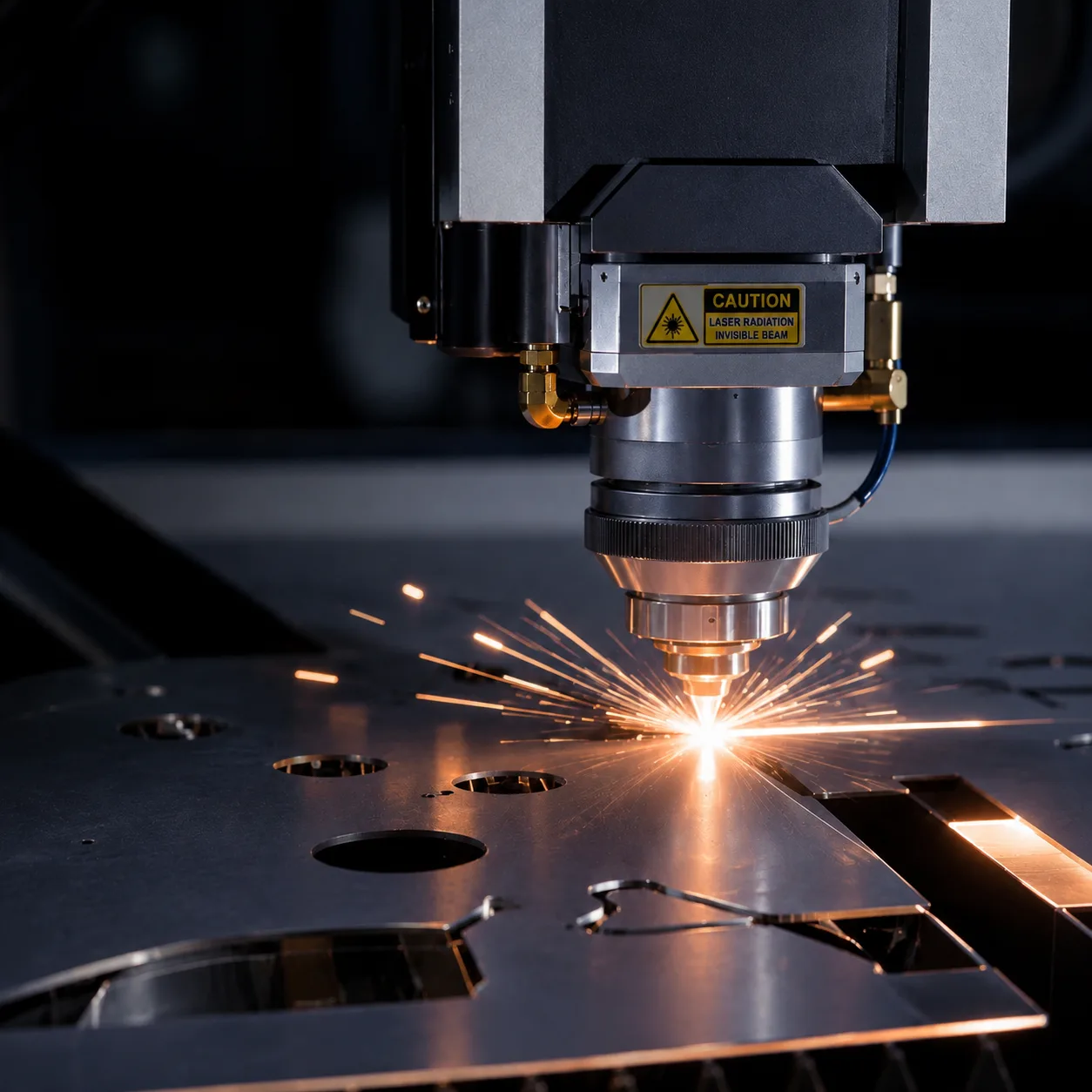
We run that chain ourselves. Fiber laser cutting and CNC turret punching produce the flat geometry. CNC press brakes form it. Progressive, compound and transfer dies stamp it when volume justifies tooling. TIG, MIG, spot and laser welding, plus riveting and hardware insertion, assemble it. Powder coating, anodizing, plating, brushing and laser engraving finish it. Ten surface finishes, one quality system, one point of accountability.
Core process capabilities
Every part we quote routes through the same capability set. The table below is what we run in-house, in the terms a workshop actually uses — not a marketing list of tick-boxes.
| Process | What it does | Typical use |
|---|---|---|
| Fiber laser cutting | Cuts flat profiles with a ±0.1 mm window and a kerf around 0.1–0.5 mm | Complex outlines, brackets, panels, one-off and low-volume work |
| CNC turret punching | Removes and forms material in single strokes — louvres, extruded holes, ribs | Repeating hole patterns, formed features laser cannot produce |
| CNC press brake bending | Forms flat blanks over a die at a programmed angle with springback compensation | Enclosures, chassis, multi-flange brackets |
| Shearing | Straight cuts on full-size sheets up to 3,000 mm | Square blanks feeding downstream forming |
| Progressive die stamping | Forms, pierces and trims inline on coil at volume | Frozen, high-volume parts where a die amortises |
| TIG / MIG / spot / laser welding | Joins formed parts into assemblies and closures | Frames, boxes, seam-welded stainless housings |
| Hardware insertion & riveting | Sets PEM inserts, standoffs and rivets after forming | Mounting features that need threads in thin sheet |
| Surface finishing | Coat, plate, anodize, brush or engrave the finished part | Corrosion protection, appearance, branding |
From prototype to production on one floor
The usual failure in fabrication is the handover: a prototype is made one way, then production is made another way by another supplier, and the two parts are not quite the same. Running every stage ourselves removes that handover. The prototype and the production part come off the same machines, measured against the same drawing.
Quantities move along one route. A single prototype is cut on the fiber laser and formed on the press brake — no tooling, quoted in 24 hours, shipped in 3–7 days. Low volume keeps the same laser-and-brake route, which needs no die and tolerates design revision between batches. Volume is where the route changes: once the design is frozen and annual demand justifies the die, we move the part to progressive die stamping, where the per-part cost falls for every order after the tooling is amortised. For a stamped part we run the first article on the production die — before volume — and issue the dimensional report against the ballooned drawing.
The point of a single route is that crossing a volume threshold is an engineering decision, not a re-sourcing project. We calculate the break-even against laser cutting and bending for your specific part and show both numbers.
- Prototype: 1 piece minimum, no tooling cost, 3–7 day turnaround.
- Low volume: same laser-and-brake route, revised freely between batches.
- Production: progressive die once the design is frozen and the die amortises.
- First article always run on the production die before volume.
Materials we fabricate
Material choice sets where a part can live: indoors, outdoors, food-contact, marine or a weldment. The five families below are the ones we run most often, and the behaviour that decides where each fits.
Two rules decide brass on our floor: brass is not fusion-welded — it is joined mechanically or by brazing, not TIG or MIG. And H62 is its own alloy, not the same as C26000, and we do not treat them as interchangeable when a drawing specifies one.
| Material | What it is good at | Where it fits |
|---|---|---|
| Mild steel / CRS | Cheap, strong, easy to form and weld | Brackets, chassis, general enclosures where weight is not critical |
| Galvanised / SECC | Zinc layer resists corrosion without painting | Outdoor cabinets, electrical enclosures, cost-sensitive outdoor parts |
| Stainless 304 / 316 | Corrosion resistance, hygiene, appearance | Food equipment, medical housings, marine and washdown environments |
| Aluminium 5052 / 6061 | Light, corrosion-resistant, good formability (5052) or machinability (6061) | Electronics enclosures, panels, weight-sensitive parts |
| Copper & brass | Conductivity and appearance; brass accepts plating well | Busbars, terminals, RF shielding, decorative trim |
Surface finishes
Finishing is where a bare part becomes a product — and it is usually the last operation, the one most exposed to batch minimums. We control the specification and the inspection; the coating, plating and anodizing are run by specialist partners we manage, not subcontracted blind.
The common finishes are powder coating (colour-matched to RAL or Pantone, for durability and appearance), anodizing (Type II or Type III on aluminium, for corrosion resistance and wear), electroplating (zinc, nickel, chrome for conductivity or protection), brushing and bead blasting (a satin or directional texture), passivation (restores stainless corrosion resistance after welding or machining), and laser engraving (permanent marking without a consumable).
- Powder coating — RAL and Pantone colour matching, durable for outdoor equipment.
- Anodizing — Type II and Type III on aluminium, with colour and hard-coat options.
- Plating — zinc, nickel and chrome for conductivity, solderability and corrosion protection.
- Brushing and bead blasting — directional satin or uniform matte before clear-coat.
- Passivation — removes free iron from stainless after welding so it does not rust at the seam.
- Laser engraving — permanent logos, part numbers and traceability marks.
Quality and inspection
ISO 9001 is the only management-system certification we hold, and we say so plainly rather than implying a broader portfolio. We do not hold IATF 16949 for automotive, ISO 13485 for medical devices or AS9100 for aerospace, and where a programme requires one of those, we will tell you at enquiry stage rather than after tooling is cut.
What we provide is the objective evidence a programme generates, treated as part of the product rather than an afterthought. On a new part we run a first article inspection against the drawing and issue a dimensional report with the material certificate. For a stamped part the FAI runs on the production die, before volume. Once the process is proven, routine production is controlled by sampling and gauges, with CMM reporting where a specification calls for it. The documentation — material certificates, coating and weld records, inspection plans — is what offshore programmes most often fail on, so it is controlled the same way as the geometry.
- First article inspection against the ballooned drawing on every new part.
- Material certificates from the mill, matching the grade and gauge specified.
- In-process inspection by sampling and gauges once the process is proven.
- CMM dimensional reporting where the drawing calls for it.
- Coating, weld and passivation records issued with the shipment.
Why a source factory, not a trading company
A trading company sources from factories and adds margin. That is a legitimate model, but a different one: there is no floor to walk, no capacity it controls, and no inspection it performs itself. The difference shows most clearly when something goes wrong — a concession, a rework, a schedule change is negotiated with the people who make the part, or relayed through a layer that may have its own interest in the answer.
The useful question is not "what do you make?" but "which operations do you run in-house, and on which machines?". A source factory answers with specific equipment and will normally volunteer what it does not do. Ask for a live video walk-through of the floor during working hours, ask which processes are partner-executed, and ask how non-conformance is handled. A real factory answers specifically; an intermediary redirects the question.
Our stamping dies are designed, built, tried out and maintained in our own die workshop rather than bought in, which is what makes the prototype-to-production path a single route instead of a handover between two companies. Some finishing operations run with specialist partners because plating and anodizing need their own certification structure and effluent handling — we name which ones rather than implying everything happens on one floor.
Industries we fabricate for
The process chain is the same across sectors; what changes is the material, the tolerance and the documentation. The programmes we run most often are below.
- Telecom — outdoor cabinets, racks and fibre hardware needing galvanised or powder-coated steel.
- Data centre & AI — racks, PDUs and thermal housings that combine sheet metal shells with precision features.
- Electronics — enclosures, brackets and shielding, often aluminium or plated steel.
- Industrial equipment — chassis, covers and frames, frequently welded assemblies.
- Food service — stainless trays, panels and washdown housings where 304 is the default.
- Renewable energy and power — busbars, brackets and enclosures, including copper and brass.
- Medical equipment — stainless housings and carts, meeting our ISO 9001 scope.
- Automotive tooling and aftermarket — brackets and fixtures, not certified automotive production parts.
How to get a quotation
Send the 3D model in STEP and a dimensioned 2D drawing — both, not one — with the material and thickness, the quantity and expected repeat rate, the finish and colour reference, and any inspection or documentation requirement. That is enough for an engineer to review manufacturability and return a costed quotation with DFM observations, normally within one working day. Prototypes we can have on a machine in days, because there is no tooling to cut first.