
How Material Thickness Affects Sheet Metal Cost
This is a cost model, not a survey. It states its inputs so you can substitute your own rates; every relationship below is arithmetic you can re-run on your part. What it will not do is quote a price.
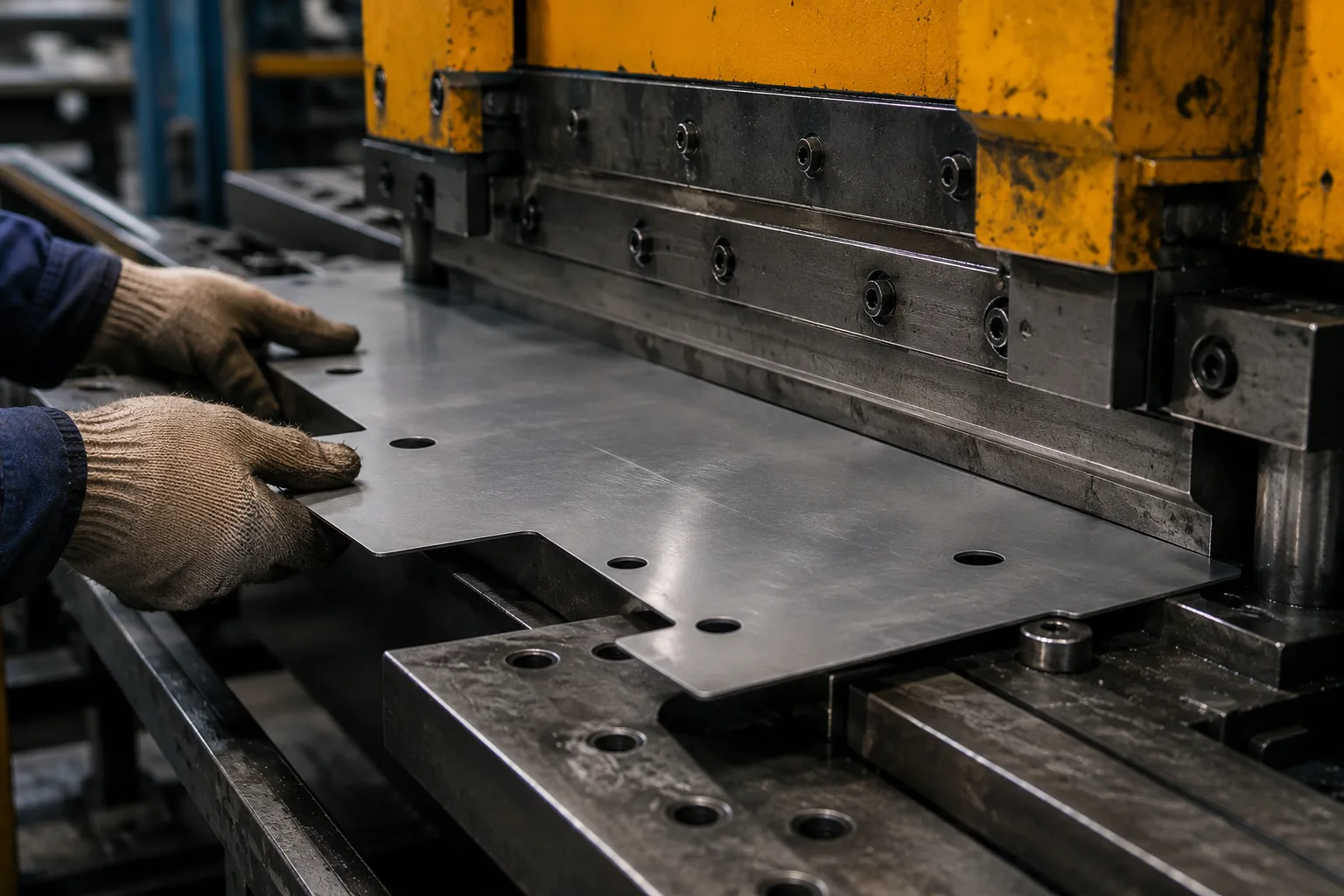
Thickness moves four costs at once: mass, cutting time, forming force and coated area. Mass rises linearly, cutting time rises faster than linearly, and forming force rises with the square of thickness for the same die. That is why doubling thickness never doubles the price — it usually more than doubles it.
Inputs, stated up front
| Input | Treatment in this model | How to adapt it |
|---|---|---|
| Material | Mild steel, density 7,850 kg/m³ | Substitute your alloy density; aluminium changes mass by roughly 1:3 |
| Material rate | Indexed to 1.00 at 1.0 mm | Scale the index by your actual kg rate |
| Shop rate | One rate for cutting and one for forming, both indexed | Use your own hourly rates |
| Cutting time | Rises with thickness, faster than linearly | Replace with your machine’s actual speed curve |
| Bend force | Proportional to thickness squared for a fixed V-die opening | Standard press brake relationship |
| Coated area | Both faces plus edges, so two thicknesses of film | Adjust if only one face is coated |
Mass: the only relationship that stays linear
Weight is simple: area × thickness × density. Doubling thickness doubles mass for the same flat pattern, so the material line on the quote doubles — and no more than doubles, provided the blank size is unchanged.
Nothing else on the quote behaves this way, which is the single most useful thing to understand about thickness. Everything downstream grows faster.
Cutting: faster than linear
A laser does not cut thick material at the same speed as thin. Cutting speed falls with thickness while pierce time, assist gas consumption and the risk of dross all rise. On top of that, a thicker sheet is often handled differently and may be cut at a lower power density to control the edge.
So while mass doubles, cutting cost on the same contour can rise by considerably more than double. On a part where cutting is the dominant cost — a panel with a lot of contour and few bends — thickness is therefore a far more expensive decision than its material weight suggests.
| Cost element | Relationship | Note |
|---|---|---|
| Material mass | Linear | Area × thickness × density |
| Cutting time | Faster than linear | Speed falls; pierce and gas consumption rise |
| Bend force | Quadratic for a fixed die | May force a wider V-die, which changes the minimum flange |
| Bend time | Broadly flat until tooling changes | A wider die or a different tooling set adds a setup |
| Coating cost | Linear in area, slightly higher per part | Both faces plus edges, and the film is unchanged |
| Form error | Worse at thickness | Springback behaviour and minimum radii tighten |
| Handling | Higher | Heavier parts cost more to move, and more to crate |
Forming: where thickness compounds
The force needed to bend a given width is proportional to thickness squared for the same V-die opening. In practice the die opening itself is usually increased as thickness rises, which brings the force back down but raises the minimum flange length and often the minimum bend radius at the same time.
That cascade is the real cost of a thickness increase. It is not the extra material. It is that a heavier sheet forces wider tooling, longer flanges, bigger radii, more springback and a heavier part to handle — and each of those is a design change, not a price change.
- Where the driver is stiffness, check a formed rib or a return flange before adding thickness.
- Where only one dimension needs more strength, consider local thickness — a folded doubler or a pressed boss.
- Confirm the minimum flange and minimum hole-to-bend distances at the new thickness before releasing the drawing.
- Expect cutting to be the line that moves most on a contour-heavy part, and forming to move most on a bend-heavy one.
Re-running this on your part
Take the flat pattern at the current thickness, apply your material rate, your machine speed curve and your forming rate, then repeat at the proposed thickness holding geometry constant. The difference in the three lines — material, cutting, forming — is the honest cost of the change, before any consequence for tooling, tolerance or handling.
Then repeat it once more with a formed stiffener instead of the thickness increase. That comparison is the one worth putting in front of your engineering review.
Frequently asked questions
Does doubling thickness double the cost?
No. Material roughly doubles, cutting rises by more than double, and forming force rises with the square of thickness for the same die opening. On a bend-heavy part the forming cascade — wider tooling, longer flanges, bigger radii — is where most of the increase lands.
Why does the die opening have to change with thickness?
Because bending force scales with thickness squared for a fixed opening, and a press has a rated tonnage. A wider V brings the force back to something the machine can do, at the cost of a longer minimum flange and usually a larger minimum bend radius. That is why thickness changes ripple into geometry.
Is thicker material more accurate?
Not in the way people expect. Thickness helps stiffness and reduces distortion from handling, but it increases springback, raises the minimum radii the material will take, and makes forming forces less forgiving. Dimensional accuracy normally comes from the process and the tooling, not from the gauge.
What is the cheapest way to make a part stiffer?
Usually a formed feature: a rib, a return flange, a hem or a change of section. These add stiffness through geometry, cost only a forming operation, and do not tighten the minimum hole size, corner radius or flange length the way a thickness increase does.
Can I model this without your rates?
Yes, and the model is designed for it. The relationships — linear for mass, faster than linear for cutting, quadratic for bend force — hold regardless of the rates you use. Substitute your own and the shape of the answer stays the same.
Send the drawing, get a real answer
An engineer reviews your model for manufacturability and returns a costed quotation — with the DFM observations that would change the price.