
What is CNC?
CNC is short for Computer Numerical Control: a machine tool that follows a stored program of coordinates and commands — G-code and M-code — rather than being driven by hand wheels and measured by eye. Put simply, the operator no longer turns the dials; a program tells the machine where to move, and it moves there the same way on part 1 and part 5,000. The technique was invented for milling in the 1950s and now runs almost every production machine on a shop floor.
Why it matters on the shop floor
The acronym is often used as shorthand for one process, CNC machining — a rotating cutter removing metal from a solid block, milling or turning. That is the common meaning, and it is a machining operation, not a sheet metal one: it takes a billet and cuts a shape out of it, where sheet metal takes a flat blank and forms it. A fabrication shop and a machine shop are different businesses with different machines.
In practice
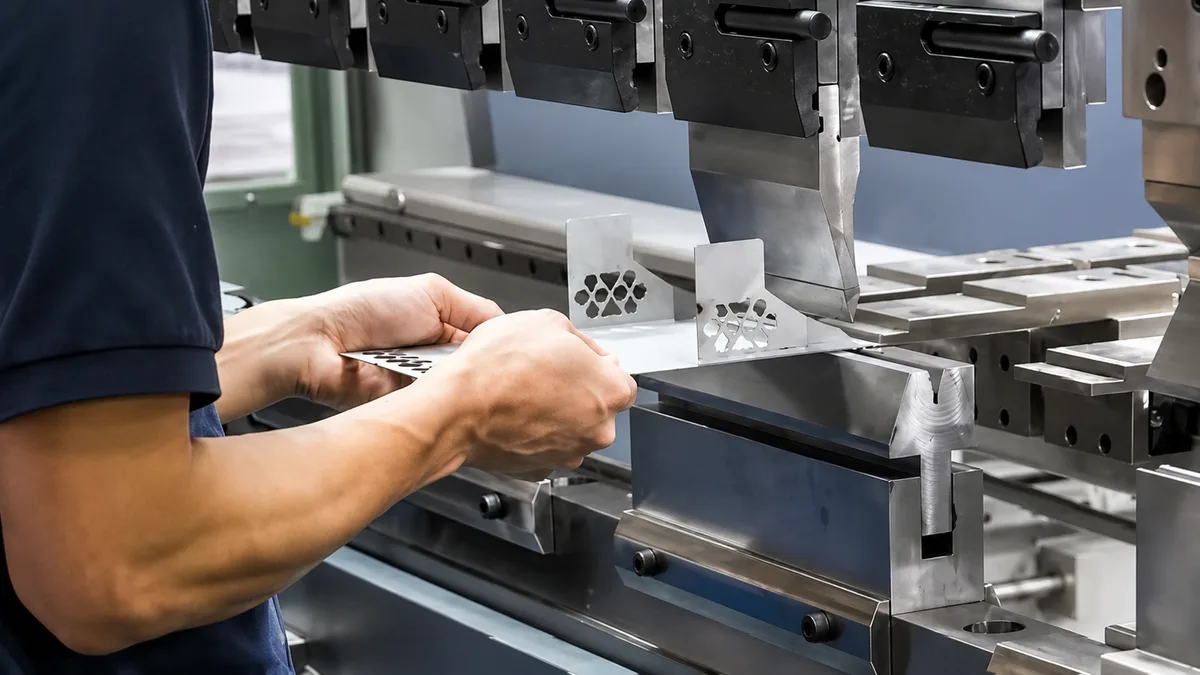
Inside our shop, "CNC" names only the two sheet metal processes whose accuracy depends on a controller reading a program: CNC bending (the press brake sets ram depth and back-gauge position from a stored program) and CNC punching (a turret press indexes its tools under program control). Laser cutting is also numerically controlled, but the trade calls the machine a laser, not a CNC. So when a drawing asks for a "CNC part," the honest first question is which operation is meant — because a milled part and a formed part are quoted, tooled and inspected differently.
What to remember
- CNC = the machine follows a program. NC, the older term, used punched tape; nobody runs either today, but the acronym survives.
- Milling and turning are CNC machining — they remove metal from solid stock and are not sheet metal operations.
- On a sheet metal drawing, "CNC" usually means the bend. Say "CNC bending" or "CNC punching" to remove the ambiguity before quoting.