
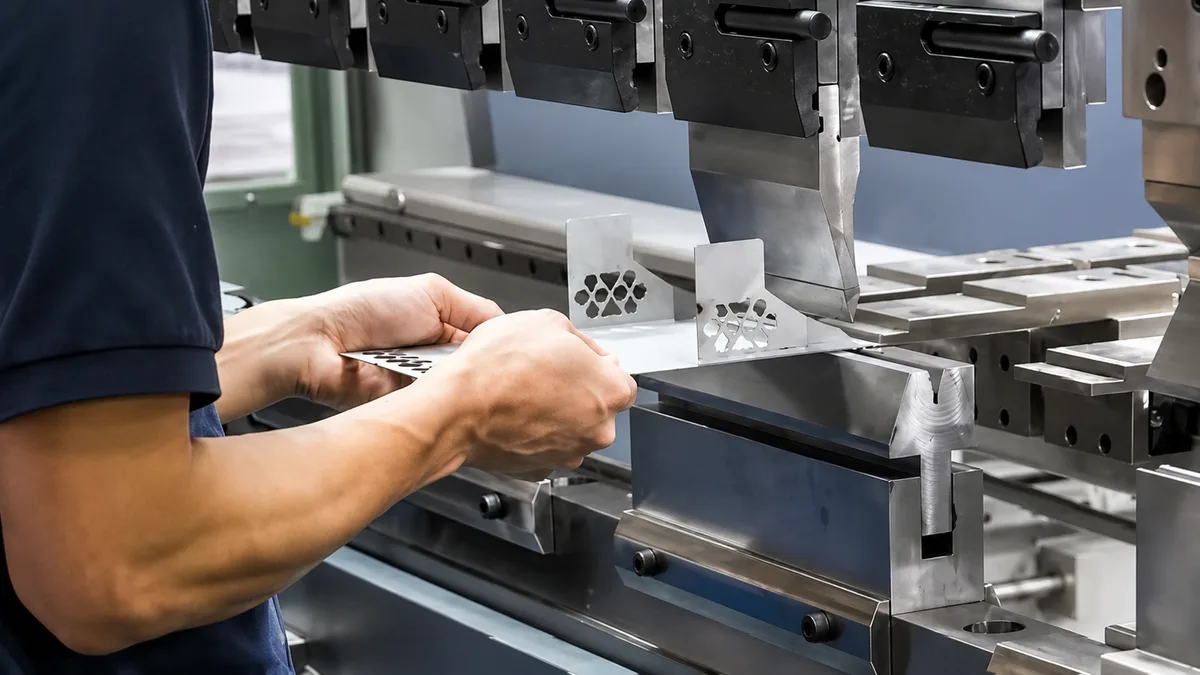
What Air Bending means
In air bending the punch presses the sheet into a V-die until the desired angle is reached, but the sheet only touches the punch tip and the two die shoulders — it never bottoms out. The angle is therefore set by ram depth, not by the tool geometry, which is why one die set bends 45°, 90° and 135° alike and why CNC depth control is the accuracy mechanism.
Why it matters on the shop floor
Air bending needs less tonnage than bottoming or coining — roughly a third of bottoming force at the same thickness — and tolerates small thickness variations. The price is springback: because the material is not fully seated, it springs back more, and the CNC compensates by overbending. Most modern press brake work, including every bend on our brakes, is air bending for exactly these reasons.
What to remember
- Lowest tonnage of the three methods — roughly ⅓ of bottoming force.
- One V-die serves many angles; tooling inventory stays small.
- Springback is larger than bottoming, so CNC overbend compensation is routine.