
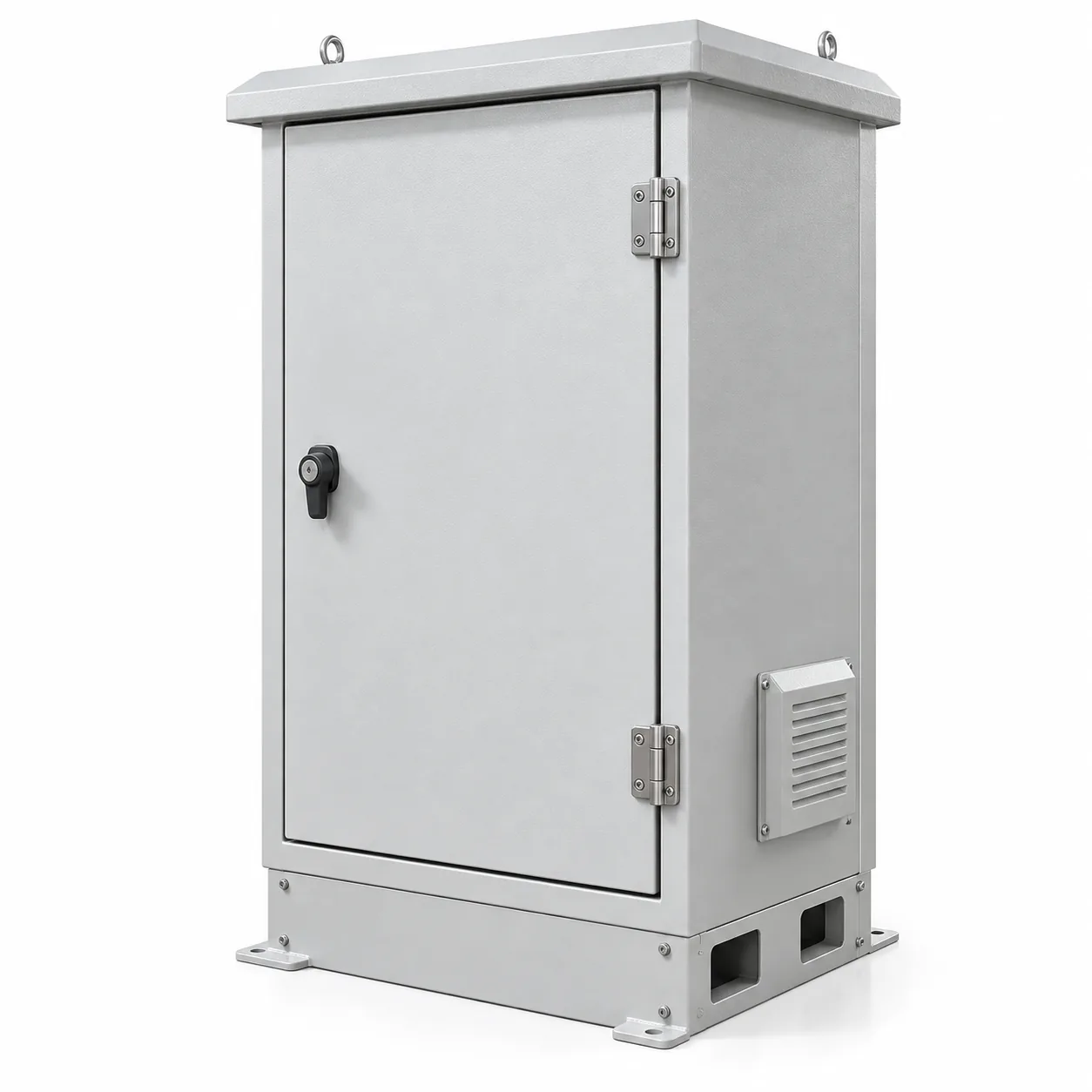
The part
| Item | Detail |
|---|---|
| Application | Outdoor street-level telecom cabinet, pole or plinth mounted |
| Material | Zinc-coated steel (SGCC), 1.5 mm body, 2.0 mm base plate |
| Route | Fibre laser cut, CNC bent, MIG welded frame, TIG welded body seams |
| Sealing | Formed gasket groove in the door, closed-cell gasket, continuous path |
| Finish | Powder coat, textured RAL, earth stud and seal lands masked |
| Tolerance | ISO 2768-m general; ±0.5 mm on the mating flange |
| Access | Front door on two hinges plus a captive quarter-turn lock |
The constraint that shaped everything
The gasket had to follow a continuous path around the door aperture and back. That eliminated the original corner design, which used a welded mitre: a weld bead at the corner interrupted the groove, and dressing it flush enough to seat a gasket was both slow and inconsistent.
The fix was to move the corner out of the seal path. The body corners were welded as before, but the gasket groove was bent as one continuous run in a single part, and the corner joint was moved behind the seal land where a bead would not matter. That is a folding decision, not a welding one, and it changed the flat pattern.
- The gasket groove is one continuous formed feature — no weld crosses it.
- Weld sequence was fixed before the flat pattern: body corners first, then the base, then dressing, then the hinge reinforcement.
- Corner radii were held at one and a half times the material thickness so the bender could form the groove without marking it.
What the drawing asked for versus what the process wanted
Three DFM changes went back with the quotation. The original door aperture had a sharp internal corner, which a laser cannot produce; the change to a 2 mm radius cost nothing and removed a secondary operation. The hinge reinforcement was originally a separate welded plate, which pulled the door and had to be straightened; folding it into the door panel as a double thickness removed both the weld and the straightening.
The third change was masking. The first drawing showed an earth stud and left the coating specification to the finish line. Powders are insulators, so the stud, its flange land and the sealing faces were nominated for masking before coating — a two-line addition that avoided an earth continuity failure discovered at the customer.
Inspection and hand-off
The first article was checked dimensionally against the ballooned drawing with the mating flange measured separately, because that is the feature the gasket relies on. Coating thickness was recorded on a sample basis, and earth continuity was verified on every unit after coating, which is the only check that actually proves the masking worked.
Units shipped with the doors removed and separately wrapped, hinges and locks in a boxed kit, and the cabinet bodies separated by interleaving. The door is the part most likely to arrive damaged on a cabinet this size, and shipping it flat removes the risk at the cost of a few minutes at the customer end.
What we would do differently
Start the gasket path earlier. The groove is the part of this design that constrains every other decision, and it was settled after the corner joints had already been drawn. Starting with the seal and building outward would have removed one design iteration, which is a week on a programme like this.