
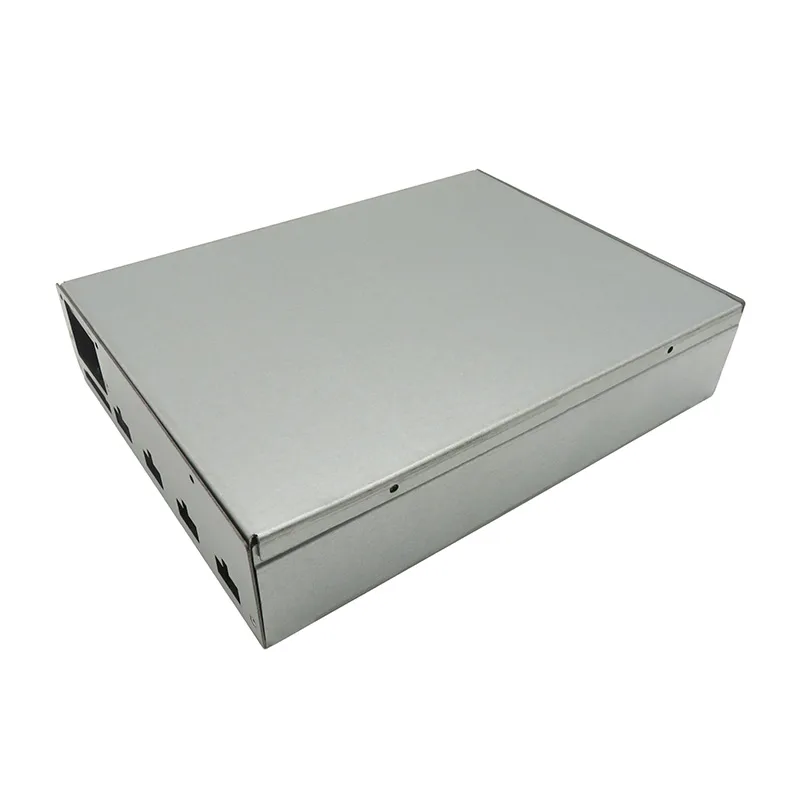
The part
Material: 5052 aluminium at 2.0 mm for the body, 3.0 mm for the mounting backplate, chosen for corrosion resistance in an outdoor coastal-adjacent environment and for thermal conductivity. Roughly 400 × 300 × 120 mm with a gasketed front cover and a separate sealed wiring compartment.
The requirement was IP65 for the electronics compartment and a specified temperature rise at full load. Salt-spray resistance was also required, which is what pushed the material away from a coated steel.
How the thermal problem was solved without vents
The first proposal added louvres, which solved the temperature and broke the ingress protection. The accepted approach was a thermal path: the power stage mounts directly to an internal bracket that is bolted to the rear face, transferring heat into the enclosure wall and then into the mounting structure and the ambient air by convection.
That decision made the mounting face a functional surface rather than a structural one. Its flatness became critical — a bowed mounting face does not conduct — so the backplate was specified thicker than the rest of the enclosure and its flatness was called out on the drawing and measured at first article.
Sealing and the details that decide it
| Feature | Decision | Why |
|---|---|---|
| Cover gasket | Continuous moulded gasket in a formed groove, compressed by fasteners at defined spacing | A hand-cut strip gasket leaves a joint at the corner |
| Fastener spacing | Tightened to a defined interval along the perimeter | A gasket only seals where it is compressed |
| Cable entries | Gland plates rather than individual drilled holes | Entries are the most common leak path and need to be serviceable |
| Drainage | Interior floor sloped to a small drain with a labyrinth path | Condensation happens; give it a way out that does not admit water |
| Finish | Chromate conversion plus a powder topcoat, with masked earth and mounting faces | Aluminium needs conversion coating before powder for adhesion |
Inspection
The gasket groove width and depth were measured on the first article, because gasket compression is set by the groove geometry and a groove that is 0.2 mm too deep leaks. Coating thickness was checked on the internal faces as well as external, and the earth stud and mounting pads were verified as bare metal.
Leak testing was agreed as an assembly-level test rather than a sheet metal one, since the seal is formed by the completed enclosure with its gasket and hardware. That distinction matters: a fabricator cannot test a seal the customer's assembly creates.
What transfers
- Sealed outdoor enclosures need a thermal path, not vents. Decide early where the heat goes and make that surface functional.
- A mounting face that conducts heat is a flatness-controlled feature, not a cosmetic one.
- Gasket sealing is geometry and fastener spacing; the material of the gasket is the smaller variable.
- Condensation is inevitable in an outdoor enclosure. Design a drain that does not admit water rather than pretending the interior stays dry.