
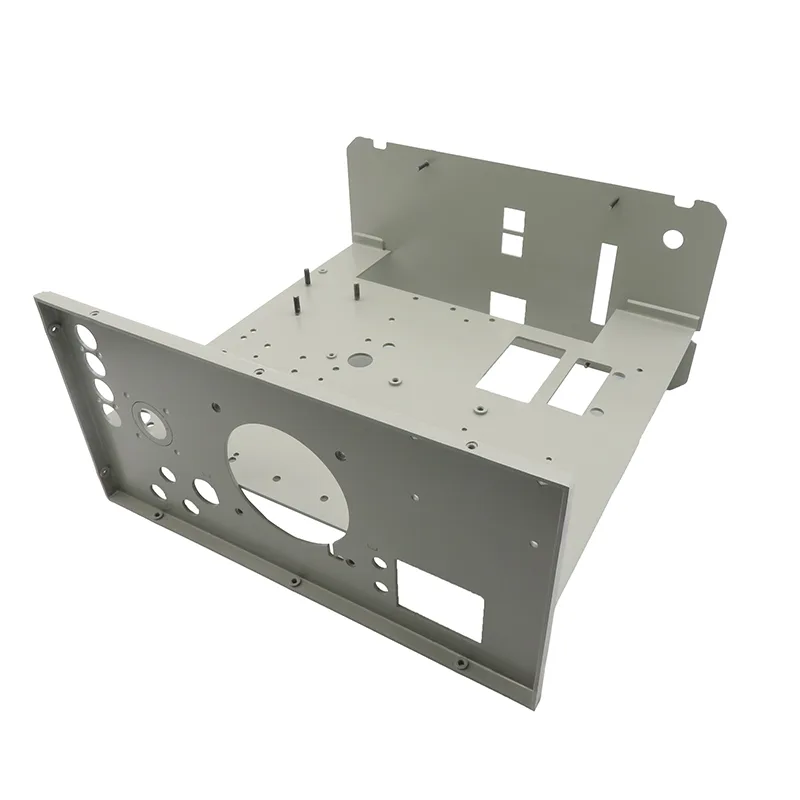
The part
Material: SPCC cold-rolled steel at 1.0 mm for the body, 1.5 mm for the front panel and rack ears. A 2U chassis with a removable top cover, a front panel carrying the I/O cut-outs, and internal rails for the customer's slide hardware. Width to the 19-inch standard, depth 600 mm.
The customer's constraint was that the chassis had to slide into a loaded rack without binding, and had to accept their existing slide kit without adaption. Both requirements point at the same two features: ear flatness and rail position.
Rack ear flatness
The ears carry the entire weight of the loaded chassis on four fasteners. If they are not coplanar, the load concentrates on two of them and the chassis sits visibly out of line in the rack. Flatness is easy to lose because the ear is a small flange at the end of a large formed body, and any twist in the body reaches the ear.
The design answer was to form the ears from a separate thicker piece welded to the body rather than folding them from the body itself, which decouples ear flatness from body twist. The welding sequence then matters, and it was specified rather than left to the operator: weld, allow to cool, then dress, with ear flatness checked on a surface plate before the chassis is finished.
Slide clearance and EMC continuity
| Feature | Requirement | How it was held |
|---|---|---|
| Rack ear flatness | Coplanar, or the fasteners load unevenly | Separate ear plate, welded flat and checked on a surface plate |
| Rail position | Tighter than general tolerance so the slides do not bind | Rails formed as a separate part located from a pierced datum |
| Overall width | To the 19-inch standard, at the ears not the body | Width measured at the ears, since that is what enters the rack |
| EMC gasket land | Continuous bare-metal land for the cover gasket | Masked during coating; continuity verified on the assembly |
| Airflow paths | Vents and fan apertures aligned between panels | Apertures positioned from the same datum across all panels |
Inspection
The inspection plan starts with a rack-fit check: the chassis is offered into a reference rack before anything else is measured, because that single check catches the errors that matter and does it faster than a dimensional report. Ear flatness, overall width at the ears and rail position are then measured and recorded on the first article.
EMC gasket lands are checked for bare metal rather than measured dimensionally — the failure mode is a coating over the land, which no dimension reveals.
What transfers
- On rack-mount parts, check the rack fit first; it is the acceptance test the customer actually applies.
- Decouple cosmetic and critical features from the main body when the body is large and prone to twist.
- Locate mating features on separate parts from a common pierced datum rather than from an edge.
- Mask EMC lands deliberately and verify them as bare metal; a coated land looks correct and does not conduct.