
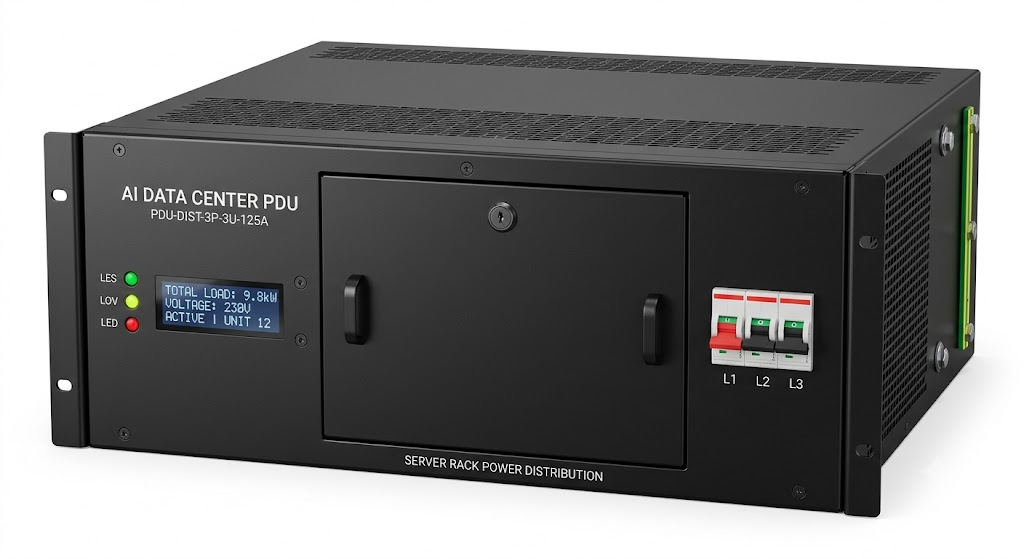
What the parts are
Racks and subracks, PDU housings, cable management arms and trays, blanking panels, airflow shrouds, and mounting brackets for power and networking equipment. Individually they are simple folded parts; together they have to interoperate to millimetre tolerances because they all reference the same rack.
| Part | Governing constraint | Consequence for the drawing |
|---|---|---|
| Rack and subrack | 19-inch interface, EIA-310 rail spacing | Fixed datum; everything else dimensions from it |
| PDU housing | Busbar clearance, purchased component envelope | Internal height is dictated, not chosen |
| Blanking panel | Airflow sealing, tool-free fitting | Light gauge, formed edges, latch detail |
| Cable tray / arm | Bend radius of the cable, load of the bundle | Depth and radius set by cable, not by stiffness |
| Cooling shroud | Open area percentage, ducted path | Perforation pattern agreed with thermal engineer |
Thermal and structural requirements pull against each other
Every opening that lets air through also removes stiffness. A 1U tray with a large perforated area twists when it is bolted into a rack, and the front panel then does not sit square. The answer is almost never more thickness — it is a formed rib behind the perforation, extended side returns, or a separate stiffener riveted in, all of which add stiffness without reducing the open area.
Perforation percentage belongs on the drawing, agreed with whoever owns the thermal model. Guessing it and then changing it later means either a new programme or a part that runs hot.
Bonding, masking and the finish
Equipment in a rack has to be bonded to earth, and a powder-coated panel is an insulator. Any surface the bonding path runs through — rail contact lands, studs, flange overlaps, the inside of a bolted joint — has to be masked before coating. It is a two-line note on the drawing and an assembly failure if it is missed.
Where a part must be conductive and also protected, the alternatives are zinc-coated steel left bare, a masked contact area, or plated hardware used for the joint rather than the painted panel. All three are cheaper than stripping a coated part.
- State the rack standard and rail spacing you are building to, not the one you assume.
- Give the perforation open-area figure and say who owns it.
- Nominate every masking area, including the inside of bolted joints.
- Check the part fits through the rack aperture and past its neighbours — model the installation, not just the part.