
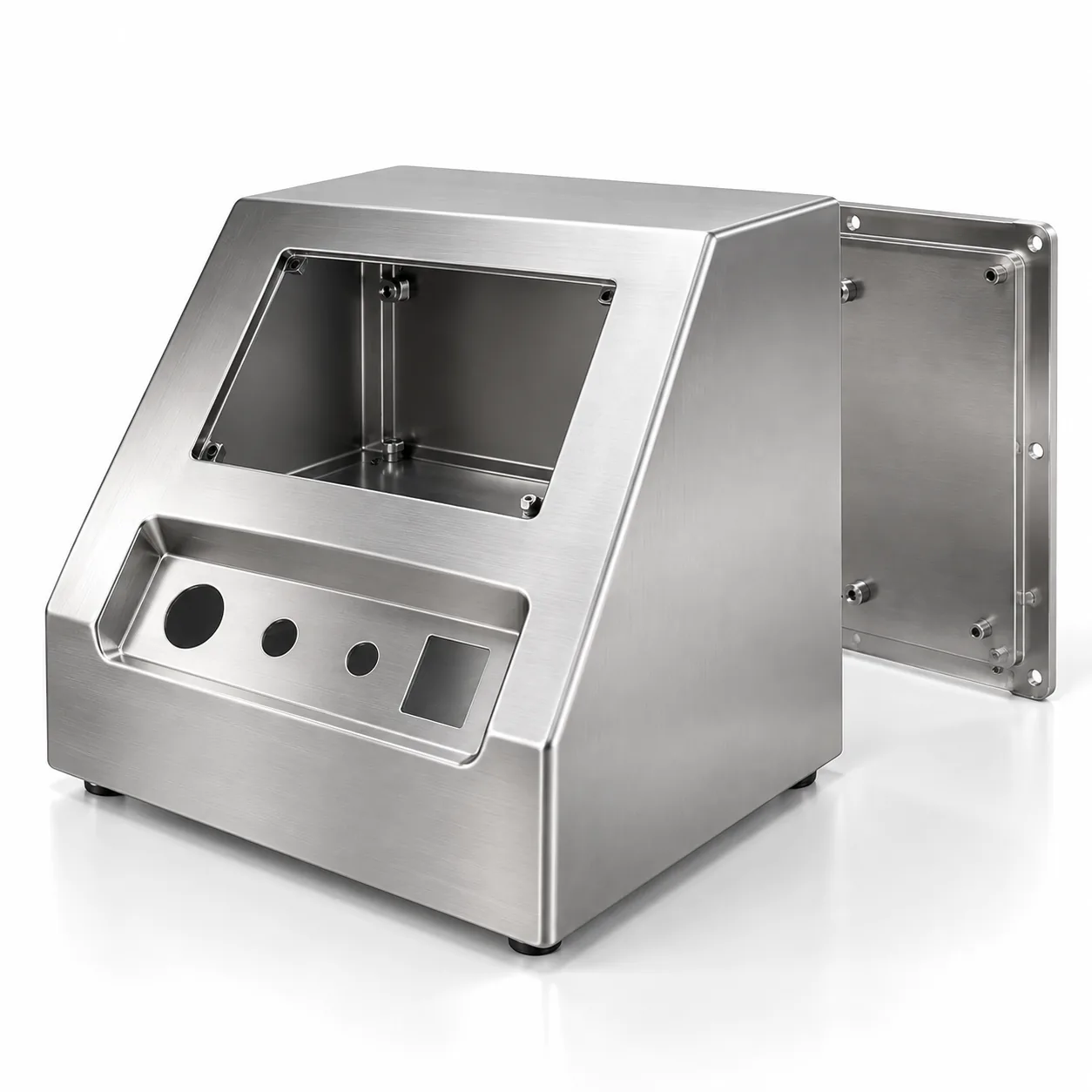
The part and the specification behind it
Material: 304 stainless at 1.2 mm for the body and 2.0 mm for the base. A five-sided enclosure with a removable rear panel, an angled front face carrying the display aperture, and a recessed control area. Roughly 350 × 300 × 180 mm.
The customer specified cleanable surfaces, no horizontal ledges where liquid could pool, and no blind crevices that a wipe could not reach. Standard tolerances applied; the surface finish and the joint geometry were the real specification.
Cleanability is a design property, not a finishing property
The instinct on a hygienic part is to specify a finer surface finish. The larger issue is geometry: a 90° internal corner between two panels is a crevice, and no amount of polishing makes it a surface a wipe can clean. Rolling the internal corners to a radius and keeping the base pan free of a return flange did more for cleanability than the finish specification did.
The same reasoning applies to fasteners. Every exposed screw head and every washer is a crevice. Where the design allowed it, the panel fixings were recessed into a machined pocket so the outer surface remained continuous.
Welding, dressing and passivation
Dressing a weld removes the passive layer with the metal. A part that is welded, dressed and shipped without passivation will show rust at the dressed area, and it will do so at the customer's site months later rather than at inspection. Passivation is not a cosmetic step; it is what makes the dressing acceptable.
| Step | Purpose |
|---|---|
| TIG welding with argon back-purge | Prevents oxidation on the inside face of the weld, which is otherwise un-cleanable |
| Dressing external welds flush | Removes the crevice between weld toe and plate that would trap residue |
| Blending dressed areas to the parent surface | Prevents a step that a wipe catches on |
| Passivation after dressing | Restores the chromium oxide layer that grinding and dressing removed |
| Deionised-water rinse and dry | Removes residue that would otherwise show as staining after passivation |
The documentation the programme actually needed
The acceptance decision turned on paperwork as much as on parts. We supplied a first-article dimensional report against the ballooned drawing, mill certificates tied to the heat number of the coil used, and a record of the passivation batch.
Being explicit about scope mattered here. ISO 9001 is the only management-system certification we hold — we do not hold ISO 13485 or a medical device quality management system, and we said so at enquiry stage. Where a programme needs the fabricator's QMS to appear in a regulatory submission, that requirement belongs with a supplier who holds the certificate. What we provide is a documented process and the objective evidence it generates, which is what this customer needed.
What transfers
- Specify cleanability as geometry: radii instead of internal corners, no horizontal ledges, no blind crevices.
- Back-purge stainless welds. An oxidised inside face cannot be cleaned and will not be seen until it matters.
- Never omit passivation after dressing; the rust appears late, at the worst possible time.
- Ask early whether the programme needs a certified QMS, because that is a supplier-qualification question, not a delivery question.