
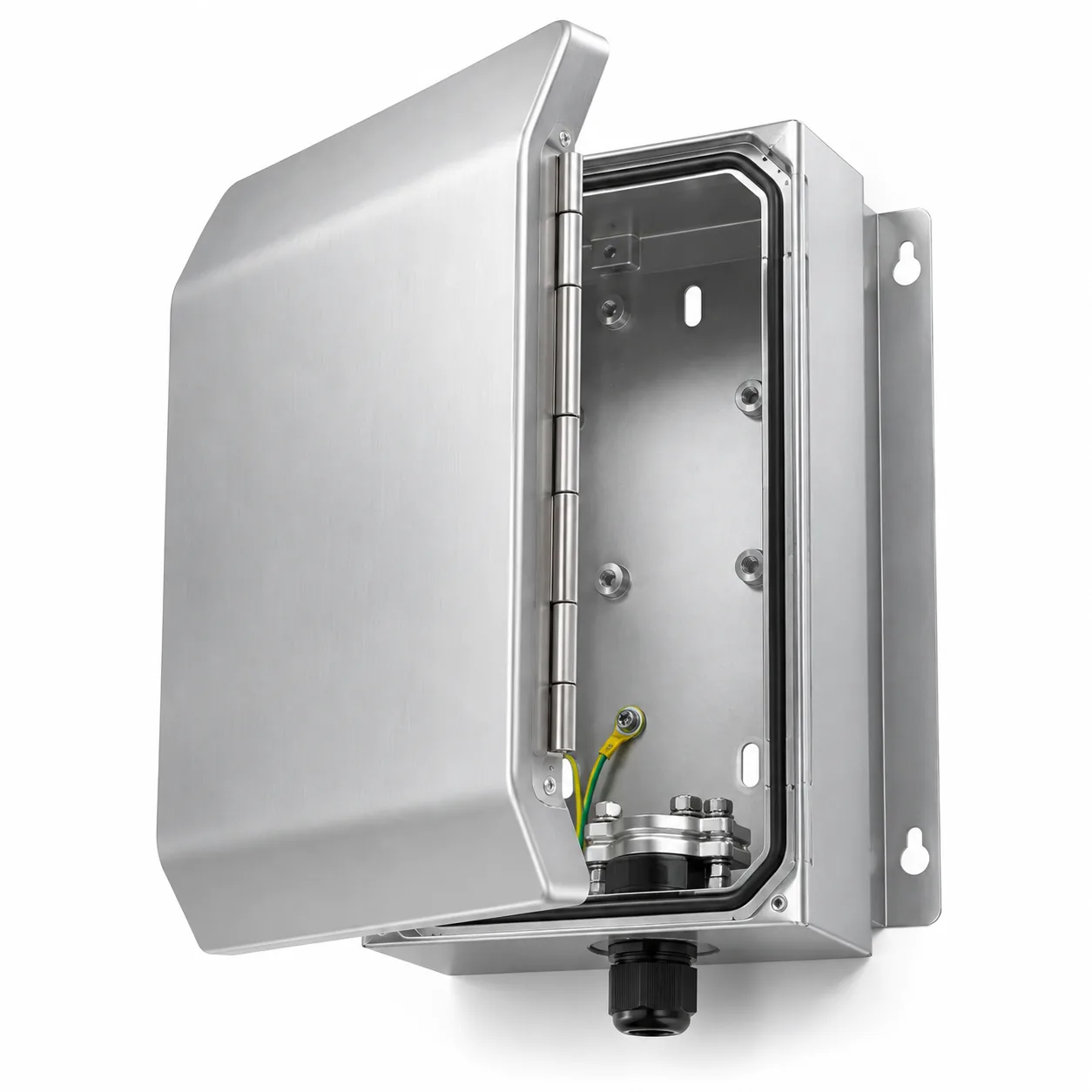
The part
| Item | Detail |
|---|---|
| Application | Wall-mounted AC charging unit, outdoor, single-piece cover |
| Body | Aluminium 5052, 2.0 mm, folded, no welding |
| Cover | Aluminium 5052, 2.0 mm, folded, hinged along the top edge |
| Sealing | Continuous gasket groove in the cover, closed-cell gasket |
| Route | Fibre laser cut, CNC bent, no welding in the enclosure itself |
| Finish | Powder coat outside, masked earth stud and gasket lands |
| Cable entry | Bottom face, strain relief bracket, gland fitted at assembly |
Sealing a hinged cover
A hinged cover has to seal along a path that includes the hinge line, which is the hardest part of the path because the hinge is where the cover moves. The groove was formed into the cover rather than the body, because the cover is the part that has to close consistently, and the hinge was placed so its axis sits outside the seal line.
The gasket lands were masked before coating, which is unusual on a cosmetic part but necessary: a gasket compresses against a surface, and a powder film there both reduces the compression and can flake as the cover is opened and closed over the life of the unit.
Earthing in a coated enclosure
The unit needs an earth path from the incoming supply to the body, and the body is painted. That means an internal stud, masked before coating, with its flange land bare as well — continuity depends on the surface under the fixing, not just on the stud.
A second, less obvious path is between the cover and the body. Where the cover carries metal parts that must be earthed, the hinge itself is not a reliable conductor after coating. A masked land and a short bonding strap rather than relying on the hinge solved it.
- Earth stud and its flange land masked before coating, and continuity tested on every unit.
- Cover bonded to the body with a strap rather than through the hinge.
- Cable entry gland seated against bare metal, not against coating.
- Internal structural fixings left as plated hardware rather than the coated body.
Aluminium, coating and the bottom face
5052 was chosen for formability and weight: the enclosure has no welds, so the whole shape comes from folding, and the material has to bend to tight radii without cracking. That also removed a pressure test and an entire welding operation, which on a high-volume consumer-facing unit matters more than the material cost difference.
The bottom face is where an outdoor enclosure usually fails first, because water collects and the cable entry is the natural weak point. The bottom was formed with a shallow slope away from the cable entry, the gland was fitted against bare metal, and the fixing was positioned so the gland compresses evenly rather than on one side.
Inspection and hand-off
First article covered the cover-to-body fit with the gasket in place, the earth continuity of the assembled unit and the hinge alignment. Coating thickness was recorded on a sample, and the masked areas were checked individually, because a missed mask is invisible once the unit is assembled.
Units shipped with the cover closed but not sealed — gasket and glands fitted at the destination — so the seal is compressed for the first time at installation rather than sitting compressed through transit.