Table of Contents
Online Sheet Metal Platforms: Who Does What
If you are sourcing custom sheet-metal parts online today, you have more choices than ever. Xometry, Protolabs, RapidDirect, and Fictiv each offer online quoting platforms with varying business models — marketplace networks, hybrid factory-and-network setups, or direct manufacturing. Each has strengths in different areas. But the question for sheet-metal buyers is not "which platform is best overall" — it is "which platform's business model delivers the best combination of price, quality, engineering support, and lead time for my sheet-metal project." This article compares WERIX against the major platforms across the dimensions that matter most for sheet-metal and stamping procurement. WERIX is a focused source factory with advantages that broad platforms cannot match for sheet metal and stamping specifically — and the data below shows exactly where those advantages are.
How the Platform Models Differ
The platforms named above operate under three distinct business models. Understanding the model tells you more about your experience than any marketing page will.
| Model | How It Works | Platforms Using It |
|---|---|---|
| Marketplace | Owns no manufacturing equipment. Matches your order to a third-party shop from a supplier network. Takes a margin (typically 15–30%) on every order. | Xometry, Fictiv |
| Hybrid (In-house + Network) | Operates some in-house capacity (often CNC or 3D printing) and supplements with a vetted supplier network for other processes. Sheet metal may or may not be in-house. | Protolabs (Protolabs Network) |
| Direct Factory (Own + Network) | Owns primary manufacturing capacity and supplements with a local supplier network. China-based, targeting global buyers. | RapidDirect |
| Source Factory | Owns 100% of the equipment, employs 100% of the operators. No network, no subcontracting for core processes. Sells direct. | WERIX |
Every platform lets you upload a file and get a quote. The web interface is similar. But the model determines who actually makes your parts, how many margins sit between you and the production line, who inspects your parts, and what happens when something needs to change mid-production. These are real differences, not marketing distinctions.
Head-to-Head: WERIX vs Each Platform
The comparison below highlights the key differences that directly affect your sheet-metal procurement experience — pricing, quality, communication, and accountability.
| Dimension | WERIX | Xometry | RapidDirect | Protolabs |
|---|---|---|---|---|
| Manufacturing model | Source factory — 100% own equipment | Marketplace — 5,000+ partner shops for sheet metal | Own factories + supplier network (China-based) | In-house digital factories + global partner network |
| Process focus | Sheet metal + stamping only — vertical specialization | CNC, 3D printing, sheet metal, injection molding, die casting, more | CNC, sheet metal, injection molding, 3D printing, die casting, PCB | CNC, injection molding, 3D printing, sheet metal |
| Pricing | Factory-direct — no platform margin | Automated pricing — includes platform margin | China factory pricing — own factories + supplier margin | Automated pricing with DFM included |
| Quote turnaround | Production-data AI within hours + senior engineer validation within 24h | Seconds — automated engine | Instant to hours — AI-powered engine | Hours to 1 day — automated DFM + pricing |
| DFM feedback | Senior engineer report with DFM fixes and cost-down recommendations | Automated DFM + engineer review available | Automated DFM analysis | Automated 3D visualized DFM on every quote |
| Engineering support | Dedicated engineer per project — direct access, same person from quote to production | Platform-based project management | Platform-based project management with engineering team | Platform-based project management |
| Quality system | 4-stage in-house QC on same floor; 98%+ first-pass yield | Quality managed at supplier level with platform oversight | Own factory QC + supplier QC; medical device quality management system certification/environmental management system certification/automotive quality management system certification | In-house QC for own factories; network QC varies |
| Lead time (sheet metal) | 3–7 days prototype; 7–15 days low volume | 3 days typical for sheet metal | 3 days prototype; 1–3 weeks production | 1 day CNC; sheet metal varies |
| IP protection | Single facility under NDA; files on dedicated servers | Files shared with matched supplier(s); NDA available | Files stored on own servers; NDA available | In-house + network; IP policy varies |
| Volume range | 1+ pcs to 50,000+ pcs — single facility | 1+ to production volume — network scales | 1+ to high volume — factory + network scales | 1+ to 100,000+ pcs — factories + network |
| Stamping capability | Full stamping: progressive, transfer, deep-draw; in-house die shop | Via supplier network | Via supplier network | Via supplier network |
Pricing: The Structural Cost Advantage of a Source Factory
Pricing is where the business model creates the most visible difference. Xometry and Fictiv operate as marketplaces — they add a platform margin (typically 15–30%) on top of the manufacturing cost charged by the partner shop. RapidDirect operates its own factories and supplements with a supplier network, so its pricing sits between marketplace and pure factory models. Protolabs positions itself as a premium option with faster turnaround and automated DFM included in the price. WERIX charges factory-floor cost plus our own operating margin. There is no platform fee, no broker commission, no routing markup. For sheet-metal parts, this structural difference typically translates to 20–35% savings versus marketplace pricing for identical specifications. The gap widens significantly on assemblies requiring multiple sub-processes (cutting + bending + welding + powder coating + assembly) because each sub-process at a marketplace platform may route to a different shop, each adding its own margin.
| Part Type | WERIX vs. Marketplace (Xometry/Fictiv) | WERIX vs. RapidDirect | WERIX vs. Protolabs |
|---|---|---|---|
| Simple bracket (1–2 processes) | 20–30% lower | Comparable — depends on routing | 30–45% lower |
| Formed enclosure (3–4 processes) | 25–35% lower | 10–20% lower | 35–50% lower |
| Welded assembly (5+ processes) | 30–45% lower | 15–30% lower | 40–55% lower |
Marketplace platforms carry overhead for platform development, marketing, project management, and supplier vetting. These costs are built into the pricing model. A source factory operates without those layers, which is why factory-direct pricing tends to be lower for comparable specifications. The difference comes from the business model, not from discounting.
Quoting: Production-Data AI vs. Industry-Benchmark AI
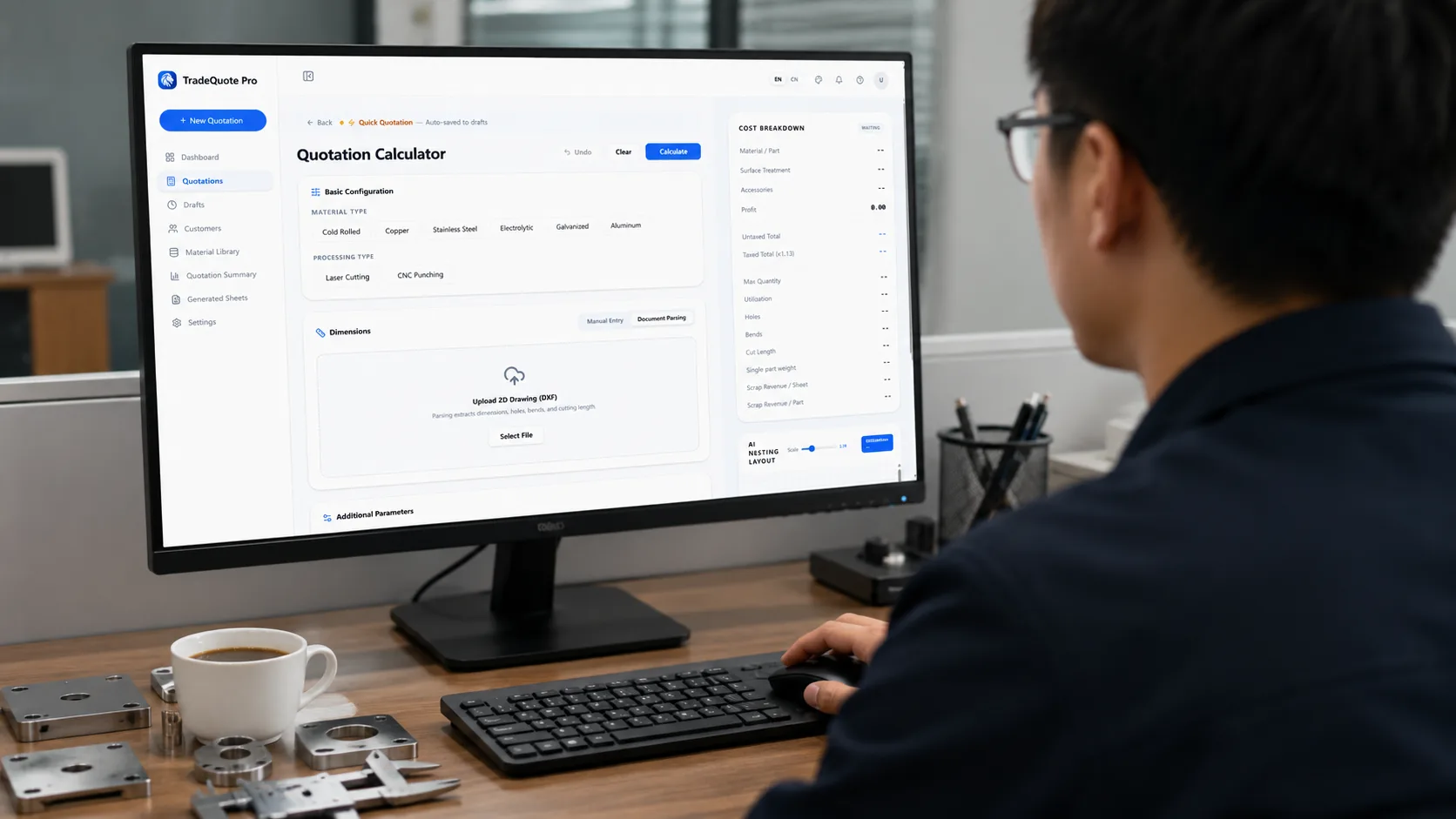
Xometry's quoting engine analyzes CAD geometry and returns a price in seconds — fully automated, calibrated to industry-average benchmarks. RapidDirect and Protolabs offer similar automated pricing with varying levels of DFM integration. All three are fast and fully automated, and all three rely on industry-average benchmarks to estimate cost — meaning the price you see is based on what similar parts typically cost across the industry, not what your specific part will cost on a specific machine. WERIX's AI-powered quotation system takes a different approach. At its core is a knowledge base built on 11 years of production data — laser cutting speeds on our Bystronic, bend cycle times on our Amada press brakes, material utilization rates, setup patterns, and thousands of completed orders with verified cost outcomes. This knowledge base is accessed through a RAG (Retrieval-Augmented Generation) architecture with a fine-tuned AI model that finds the most relevant historical production data for each new part geometry, then generates pricing calibrated to our actual equipment performance. When the system prices a 2 mm stainless bracket with four bends and a powder-coat finish, it pulls production records from parts with similar geometry, material, and complexity on our floor — not an industry average. The result is accurate, production-verified pricing from the first pass. But we do not treat AI as infallible. Every quote is reviewed by a senior engineer who verifies DFM feasibility, checks material availability, and adjusts for project-specific factors — tolerances, surface finish requirements, batch-specific logistics — that no algorithm can fully anticipate. The AI handles the heavy calculation; the engineer handles the judgment.
- Proprietary knowledge base — 11 years of WERIX production data: cycle times, material costs, setup patterns, and verified order outcomes
- RAG architecture with fine-tuned AI model — finds the most relevant historical data for each new part geometry and generates pricing calibrated to our equipment
- Covers both sheet metal and stamping feasibility — the system recommends the optimal process based on volume, geometry, and cost
- Every quote reviewed by a senior engineer: DFM verification, material check, and project-specific adjustments
- PDF quote with product image, pricing breakdown, and DFM notes — shareable with your procurement team
Sheet Metal Focus vs. Broad Platform Breadth
Xometry covers CNC, 3D printing, sheet metal, injection molding, die casting, and more — over a dozen manufacturing processes. RapidDirect and Protolabs offer similar breadth. Breadth is their value proposition: one account, one interface, many processes. WERIX deliberately specializes in sheet metal fabrication and metal stamping — the two disciplines where depth of expertise delivers the most value to buyers. Every engineer on our team specializes in sheet-metal DFM — bend sequence planning, flange-to-hole distance optimization, weld distortion management, stamping die design. Our 11 years of production data and our RAG-powered AI knowledge base cover one domain in detail, which is why our quoting system is calibrated to actual sheet-metal and stamping operations rather than generic manufacturing benchmarks. For the sheet-metal and stamping portions of your BOM, this vertical specialization delivers more accurate quoting, deeper DFM feedback, and tighter quality control than a generalist platform — and many customers use WERIX alongside their CNC supplier for the best of both approaches.
If your project is purely sheet metal and stamping — enclosures, brackets, panels, welded assemblies, stamped parts — a specialized source factory delivers deeper engineering expertise, more accurate pricing calibrated to actual equipment, and a quality system built around one manufacturing discipline. If your BOM also includes CNC or 3D-printed parts, a broad platform can source those processes — but for sheet metal specifically, WERIX's vertical focus is a real advantage.
Prototype to Production: One Factory, Three Pathways
Switching suppliers between prototype and production is one of the most common risks in manufacturing sourcing. The vendor who makes your 5-piece sample may not be set up for your 10,000-piece production run, and qualifying a new supplier mid-project means re-sending files, re-validating quality, and rebuilding the working relationship from scratch. Most broad platforms handle this by routing prototypes to different shops than production runs — the platform stays the same, but the factory making your parts changes. WERIX solves it differently: all three pathways run in the same 3,000+ sqm facility, on the same equipment, inspected by the same QC team.
| Pathway | Volume | Lead Time | Key Feature |
|---|---|---|---|
| Rapid Prototyping | 1+ pieces | 3–7 business days | Zero tooling cost; production-grade materials and equipment |
| Low Volume Production | 50+ pieces | 7–15 business days | In-process QC, batch traceability, dedicated engineer |
| Mass Production (NPI) | 5,000+ pieces | Project-dependent | Full 8-phase NPI pipeline, in-house die shop, 99.5% first-pass yield (NPI) |
Your prototype parts are cut on the same Bystronic laser, bent on the same Amada press brake, and inspected by the same QC team as your production parts. The transition from sampling to production is a scheduling change — not a supplier change. Your dedicated engineer manages the entire progression from first article to mass production delivery.
When WERIX's Source Factory Model Delivers the Most Value
For sheet metal and stamping projects, the source factory model offers advantages that broad platforms cannot match. Here is where WERIX's model creates the most value:
- Sheet-metal-only or stamping-heavy projects — every engineer, every machine, and every QC process is optimized for one manufacturing discipline, not spread across ten.
- Assemblies requiring multiple sub-processes (cutting + bending + welding + powder coating + assembly) — all under one roof, one PO, one engineer. No multi-vendor coordination, no margin stacking.
- Cost-sensitive production volumes — factory-direct pricing with no platform margin means 20–35% lower unit cost on standard parts, and the gap widens on complex assemblies.
- Projects that need a clear prototype-to-production path — same factory, same equipment, same quality standard from first sample to 50,000-piece production run.
- Engineers who want direct access to a production engineer — not a platform project manager. Your WERIX engineer walks the same floor where your parts are made.
- IP-sensitive projects — your design stays in one facility under NDA. No routing across a network of undisclosed shops.
FAQ
Written by
Tom
Senior Process Engineer
Experienced manufacturing engineer specializing in sheet metal fabrication, CNC machining, and surface finishing. Writes practical guides to help engineers make informed sourcing decisions.
Ready to Start Your Project?
Get DFM feedback and a quote within 24 hours. No minimum order quantity.