
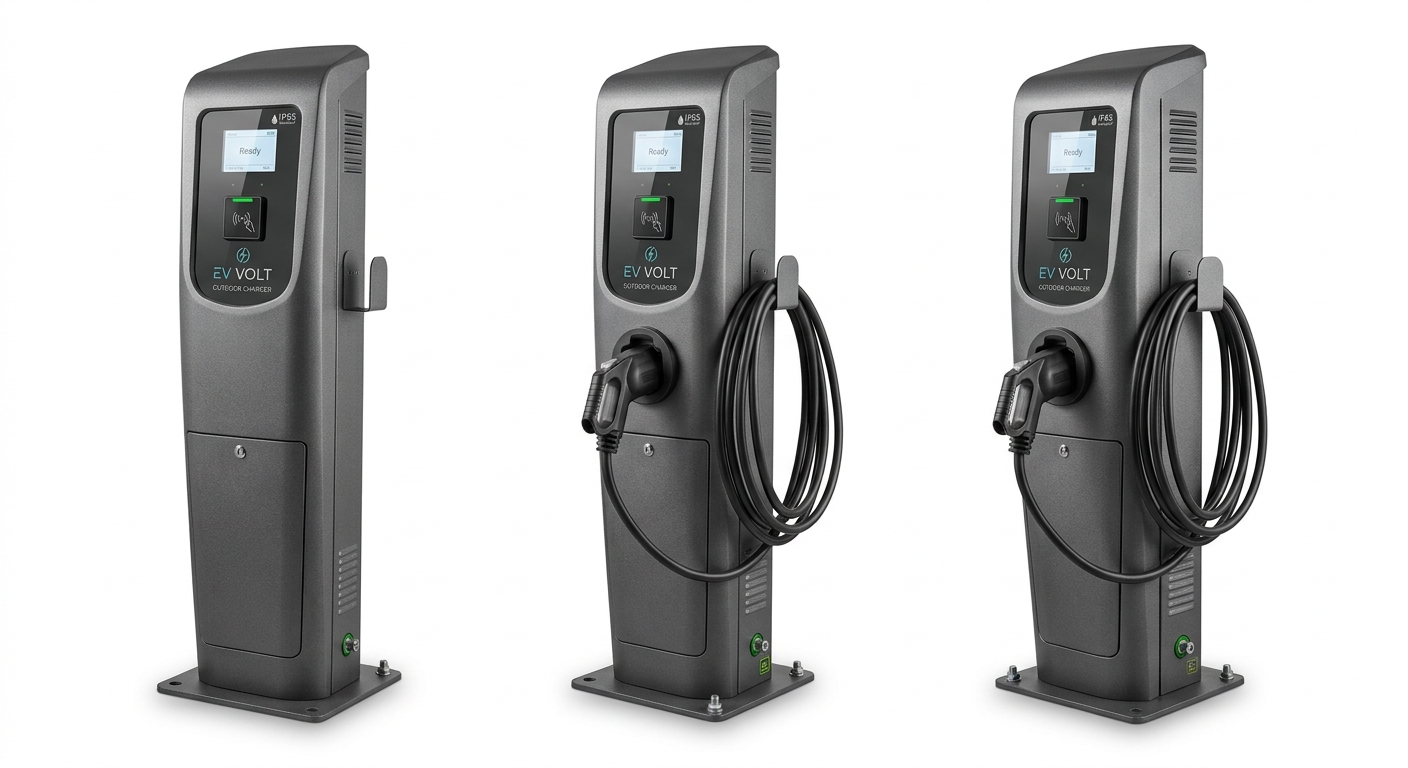
Sealing, and where it usually fails
An AC wallbox has a single cover that opens for installation; a DC cabinet has doors, cable management and often liquid cooling. In both cases the seal is a continuous path that must survive being opened for commissioning and again for service.
The two failure points are the hinge line and the cable entry. Placing the hinge axis outside the seal path and forming the gasket groove into the moving part keeps the path unbroken; bedding the gland against bare metal, on a face that drains away from the seal, handles the entry. A flat flange with a stick-on gasket is cheaper and is where most field leaks originate.
| Aspect | AC wallbox | DC fast charger |
|---|---|---|
| Size and structure | Single folded body, no weld | Welded frame with bolted or welded skin |
| Sealing | One continuous cover gasket | Multiple doors, seals and gland interfaces |
| Thermal | Passive; small vent area | Forced air or liquid cooling, larger openings |
| Earthing path | One stud and a cover bond | Multiple bonded panels, each needing a masked land |
| Material | 5052 aluminium or coated steel | Coated steel or stainless for kerbside |
| Appearance | Consumer-facing; colour and texture matter | Public infrastructure; vandal resistance matters |
Earthing through a painted body
Every metallic part that a user can touch has to be bonded, and every bond runs through bare metal. A powder-coated stud is an insulator; so is the inside of a bolted joint between two coated panels. The drawing therefore has to nominate every bonded surface for masking, and the finished unit should be continuity-tested rather than assumed.
On a DC cabinet with several panels this is easy to under-specify. A bonded door needs a masked land and a strap; the hinge is not a reliable conductor once it is coated, and relying on it is the kind of design decision that passes prototype testing and fails in the field.
Making it survive the outside
Kerbside charging equipment takes impacts and spray. The finish is chosen for UV stability and chip resistance, edges that a hand or a hose will meet are formed or deburred, and fixings are either the same material as the panel or protected from the galvanic couple. Where the unit sits on a coastal site, the specification moves to stainless and the fasteners move with it.
Cable management is part of the product, not an accessory: the entry, the strain relief, the drip loop and the holster or cable retainer all interact with the enclosure, and all of them are easier to design in than to add afterwards.