
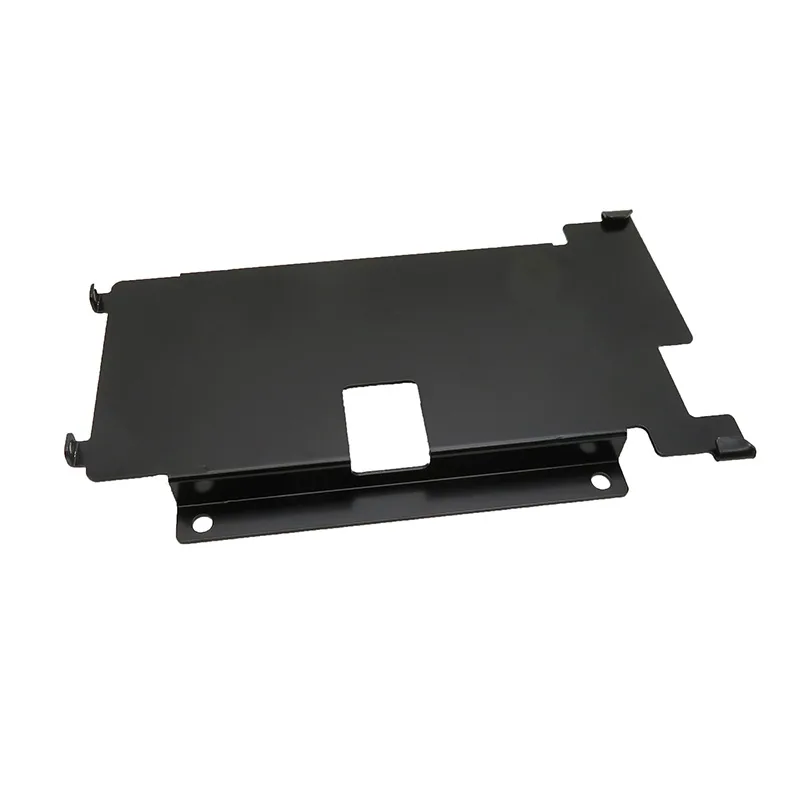
The part
Material: SPCC cold-rolled steel at 1.5 mm for frames and 2.0 mm for the door leaf, with a powder coat finish resistant to coolant and chip contact. Guarding for a machining centre: two fixed panels, one sliding door and a hinged access panel, all built on a common frame.
The operating requirement was that the operator must be able to watch the cut without opening the guard, and that the door must be interlocked so the spindle stops before the door can be opened. Both requirements are geometry decisions made at design stage.
Choosing the aperture
An open mesh or louvre lets the operator see the work and lets chips and coolant escape. A solid panel contains everything and blocks the view. The compromise that works on most machining centres is a split: mesh at the level where chips are thrown, clear material at eye level where the operator needs to observe.
Aperture size is not a free choice. It has to be small enough to prevent access to the hazard zone, which is a function of the distance from the aperture to the danger — the further away the operator can reach, the larger the aperture may be. That calculation is a design input, not a shop decision, and it belongs on the drawing with the distance it was based on.
Frames, doors and coolant
| Feature | Decision | Reason |
|---|---|---|
| Panel frames | Formed channel with a folded return, not a flat panel | A flat 1.5 mm panel vibrates and drums in service |
| Mesh retention | Mesh captured in a formed groove and spot-welded | Adhesive and loose fixings fail under continuous vibration |
| Door leaf | Separate 2.0 mm leaf on its own frame | Door flatness is a functional requirement, not cosmetic |
| Bottom edge of the door | Sloped inwards and drained | Coolant runs down a vertical door and out onto the floor |
| Finish | Powder coat with a chemical-resistant product | Standard decorative powders stain and soften under coolant |
| Sight line | Clear panel at eye level, retaining frame on the inside | Keeps fixings out of the operator's field of view |
Interlock and inspection
The interlock switch is mounted to the fixed frame and actuated by the door, so its alignment depends on the frame rather than on the panel. That is deliberate: a switch mounted to a panel moves whenever the panel does, which produces intermittent faults that are expensive to diagnose.
Inspection covered frame squareness, door clearance at full travel, mesh aperture dimensions against the specified size, and the interlock mounting geometry. Where guarding is part of a machine's safety function, the acceptance criteria are usually defined by the machine builder or by the relevant standard rather than by us, and we inspect to what they define.
What transfers
- Decide what must be hidden and what must be seen; that split drives the whole panel design.
- Aperture size is a safety calculation based on distance, not a styling choice.
- Mount safety switches to the fixed structure. A switch on a moving panel drifts.
- Contain coolant with geometry — sloped edges and drainage — rather than relying on sealing a moving door.
- Specify a finish for the environment. Coolant and swarf are aggressive on decorative coatings.