
目次
Why Source Sheet Metal From China
China remains the world's largest sheet metal fabrication market, producing an estimated 30%+ of global fabricated metal products. For international buyers — particularly in North America, Europe, and Australia — the cost advantage of sourcing from China is well-established but often misunderstood. The savings are not simply about cheap labor. They come from a combination of lower material procurement costs (China's domestic steel and aluminum markets benefit from large-scale integrated mills), factory density that creates competitive pricing pressure, mature supply chains for finishing and hardware, and — when you work with the right factory — genuine manufacturing efficiency built over decades of export production.
| Cost Factor | North America / Europe | China (Direct Factory) | Typical Savings |
|---|---|---|---|
| Mild steel sheet (1.5 mm) | $1.20–$1.80/kg | $0.70–$1.10/kg | 25–40% |
| Laser cutting (per meter) | $0.08–$0.15/mm path | $0.03–$0.06/mm path | 50–65% |
| CNC bending (per bend) | $1.50–$3.00/bend | $0.30–$0.80/bend | 60–75% |
| Powder coating | $2.00–$5.00/part | $0.50–$1.50/part | 60–75% |
| Skilled operator hourly rate | $25–$50/hr | $5–$10/hr | 70–80% |
When shipping, duties, and quality risk are factored in, the net cost advantage for a direct source factory typically runs 20–40% versus domestic North American or European shops for standard sheet-metal parts. The gap widens on assemblies requiring multiple sub-processes (cutting + bending + welding + coating + assembly) because the integrated supply chain in Guangdong province — where most export sheet-metal factories cluster — eliminates inter-vendor coordination costs that domestic multi-vendor supply chains cannot avoid.
When shipping, duties, and quality risk are factored in, the net cost advantage for a direct source factory typically runs 20–40% versus domestic North American or European shops for standard sheet-metal parts. The gap widens on assemblies requiring multiple sub-processes (cutting + bending + welding + coating + assembly) because the integrated supply chain in Guangdong province — where most export sheet-metal factories cluster — eliminates inter-vendor coordination costs that domestic multi-vendor supply chains cannot avoid.
How to Find Reliable Suppliers
Finding a sheet-metal supplier in China is easy — there are thousands. Finding one that consistently delivers quality parts, on time, at quoted prices, with proper documentation is the hard part. Here are the four main channels for finding suppliers, with the strengths and limitations of each.
| Channel | Strengths | Limitations |
|---|---|---|
| B2B platforms (Alibaba, Made-in-China) | Large database; easy to compare; trade assurance available | Mixed quality; many are trading companies not factories; vetting required |
| Trade shows (Canton Fair, CIEME) | Face-to-face meetings; see samples; assess factory representation | Limited to exhibitors; annual or semi-annual timing; travel cost |
| Industry referrals | Pre-vetted by trusted contacts; real production experience | Limited network; may not match your specific requirements |
| Direct source factory websites | Direct contact with manufacturer; transparent capabilities | Requires due diligence; fewer reviews available online |
Regardless of the channel, the critical step is verifying that the entity you are dealing with is an actual manufacturing factory — not a trading company that outsources production and adds 15–30% margin. Trading companies are not inherently bad, but if factory-direct pricing and direct engineering communication are important to your project, you need to confirm manufacturing ownership. The factory audit checklist in the next section gives you a concrete framework for this verification.
Trading Company vs. Source Factory
A trading company does not own manufacturing equipment — it sources from factories and adds a margin. A source factory owns the equipment, employs the operators, and sells direct. The pricing difference is structural: 15–30% markup for trading companies, zero markup for direct factories. Ask to see equipment photos, a facility video tour, or schedule a live video call showing the production floor.
Regardless of the channel, the critical step is verifying that the entity you are dealing with is an actual manufacturing factory — not a trading company that outsources production and adds 15–30% margin. Trading companies are not inherently bad, but if factory-direct pricing and direct engineering communication are important to your project, you need to confirm manufacturing ownership. The factory audit checklist in the next section gives you a concrete framework for this verification.
The 10-Point Factory Audit Checklist
Before committing to a Chinese sheet-metal supplier, verify these ten points. You can conduct this audit through a combination of document requests, video calls, and — for large-volume orders — an in-person visit or third-party audit.
- Business license and registration — verify the company name matches the entity you are contracting with; confirm the license covers manufacturing, not just trading
- Equipment list with photos — request a list of all major equipment (laser, press brake, punch, welding, finishing) with model numbers, tonnage, and bed sizes; match photos against the claimed equipment list
- Facility tour (video or in-person) — walk the production floor via live video call; look for organized workstations, active production, and quality documentation posted at each station
- Quality system documentation — request evidence of incoming material inspection, in-process checks, final inspection protocols, and calibration records for measurement instruments
- Export experience — ask for references from your country or region; request contact information for 2–3 existing clients willing to provide a reference
- Sample parts with dimensional report — before placing a production order, request sample parts made from your drawing with a CMM dimensional report confirming key tolerances
- Dedicated engineer assignment — confirm that a single engineer will handle your project from quote through production; ask for the engineer's background and experience level
- Communication channels — confirm English-language capability, response time expectations, and preferred communication tools (email, WeChat, WhatsApp, video call)
- NDA and IP protection — sign a non-disclosure agreement before sharing CAD files; verify that the factory has a file-security protocol and does not share designs with third parties
- Financial stability — for large-volume orders, verify the factory's financial health through trade references, years in operation, and client base diversity
Red Flags During Audit
Be cautious if the supplier: refuses to show the production floor on video, cannot provide equipment model numbers, has no existing export clients in your region, quotes prices dramatically below the market average (30%+ lower than other quotes), or cannot assign a named engineer to your project. These signals suggest a trading company, an under-resourced factory, or a supplier that will cut corners on quality.
Quote Process and Typical Lead Times
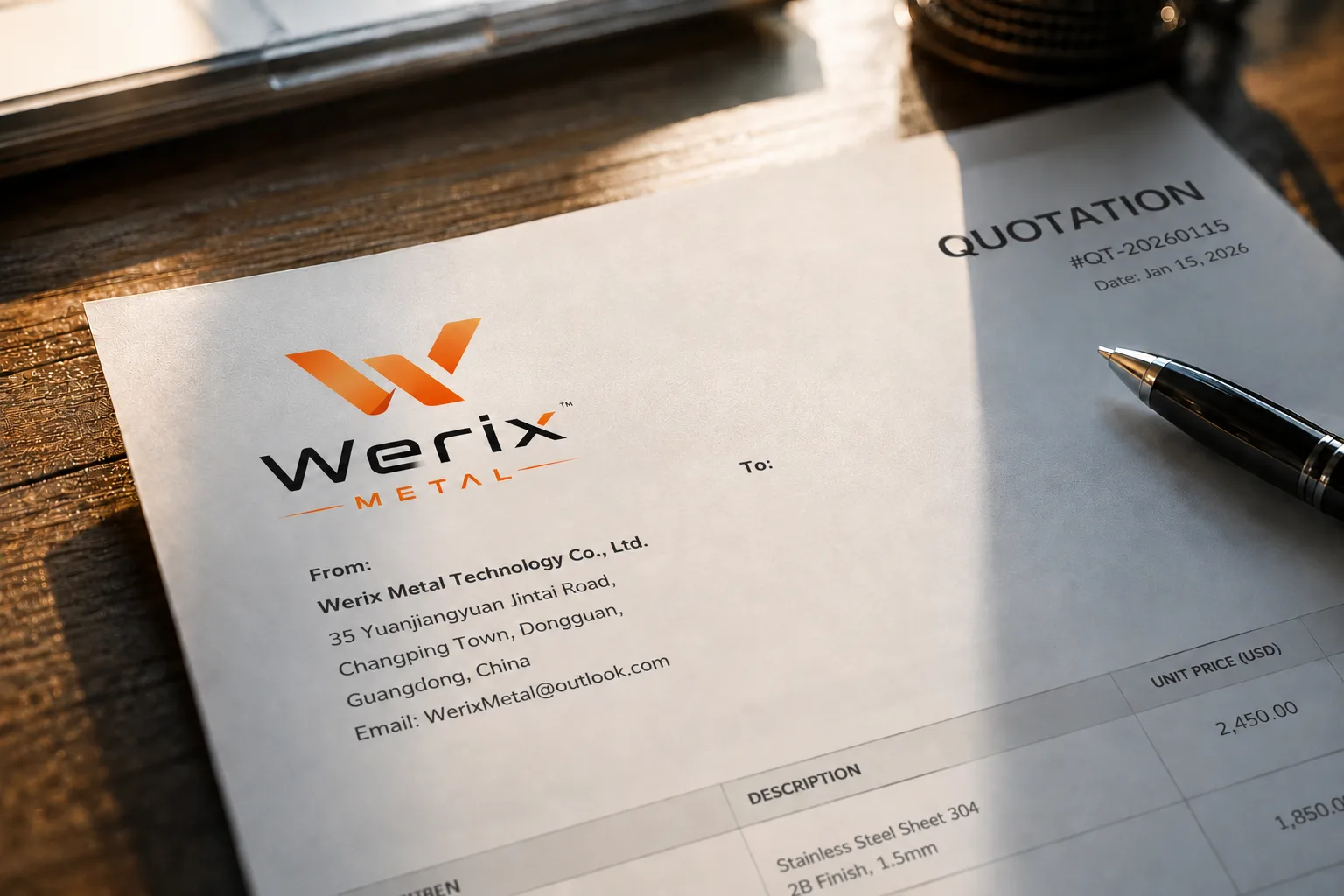
The quoting process for Chinese sheet-metal suppliers follows a standard pattern, though the speed and depth of DFM feedback varies significantly by supplier model. Source factories with AI-assisted quoting can deliver pricing within 24 hours for standard parts; traditional factories may take 3–5 business days.
| Stage | What You Provide | What You Receive | Typical Timeline |
|---|---|---|---|
| Initial inquiry | CAD file (STEP/IGES/DXF), material, quantity, finish spec | Acknowledgment + engineer assignment | Same day to 24 hours |
| DFM review | — | Feasibility confirmation, DFM flags, cost-down suggestions | 1–2 business days |
| Formal quote | Written approval or PO | Itemized quote: per-part price, material spec, lead time, Incoterms | Within 24 hours (AI-assisted) or 2–5 days (traditional) |
| Sampling | Design freeze confirmation | First-article samples + dimensional report | 3–7 business days |
| Sample approval | Written approval | Production scheduling, tooling (if stamping) | Customer-dependent |
| Production | — | In-process QC updates, packing photos before shipment | 7–30 days depending on volume |
Total lead time from file upload to delivery of samples is typically 2–4 weeks (including international shipping). Production lead time after sample approval is typically 2–6 weeks depending on volume and finishing requirements. For stamping orders, add 2–4 weeks for die fabrication and tryout. Expedited timelines are often available for an additional fee — ask your engineer at the quoting stage.
Total lead time from file upload to delivery of samples is typically 2–4 weeks (including international shipping). Production lead time after sample approval is typically 2–6 weeks depending on volume and finishing requirements. For stamping orders, add 2–4 weeks for die fabrication and tryout. Expedited timelines are often available for an additional fee — ask your engineer at the quoting stage.
Common Pitfalls and How to Avoid Them
Sourcing from China is well-established, but common mistakes still cost buyers time, money, and quality problems. Here are the pitfalls we see most frequently — and how to avoid each one.
| Pitfall | Consequence | How to Avoid |
|---|---|---|
| Awarding on lowest price alone | Quality issues, corner-cutting on coating thickness or material grade | Normalize quotes to the same scope; verify scope includes all your requirements |
| Not verifying factory ownership | Paying trading-company markup (15–30%) without knowing it | Request equipment photos, facility video tour, and business license verification |
| Skipping sample approval | Production parts do not match expectations | Always approve physical samples with a dimensional report before production |
| Vague specifications | Supplier fills in the gaps with lowest-cost options | Specify exact material grade (UNS/EN), coating type and thickness, and all critical tolerances on the drawing |
| No NDA before sharing files | IP risk — designs may be shared or copied | Sign NDA before uploading CAD files; verify the factory has file-security protocols |
| Assuming Western communication norms | Delayed responses, indirect answers to technical questions | Set clear expectations for response time; use structured communication; confirm understanding in writing |
| Ignoring Incoterms | Unexpected costs for duties, freight, or insurance | Always specify Incoterms (FOB, DDP, CIF) in the PO; clarify who pays for customs and delivery |
The Single Most Important Step
Request physical samples with a CMM dimensional report before committing to production. This single step eliminates the majority of quality surprises. A supplier confident in their capability will provide samples without hesitation. A supplier that resists or delays sample delivery is signaling risk.
Quality Control and Inspection Process
Quality control in Chinese sheet-metal fabrication ranges from basic visual inspection to comprehensive multi-stage QC systems — the level depends on the supplier. A well-structured QC process for sheet-metal parts should cover four stages, and you should verify that your supplier implements all four.
- Stage 1 — Incoming material inspection: raw sheet stock is checked for thickness (±0.05 mm), grade certification (mill cert), and surface condition before entering production. Reject material that does not match the ordered specification.
- Stage 2 — In-process dimensional check: first-article inspection at every workstation (laser, bend, weld, stamp) plus statistical random sampling throughout the run. Catches drift before it produces scrap.
- Stage 3 — Final inspection: dimensions verified against your drawing with precision instruments — CMM, calipers, micrometers. Tight-tolerance parts (±0.05 mm) receive CMM scanning with full GD&T validation.
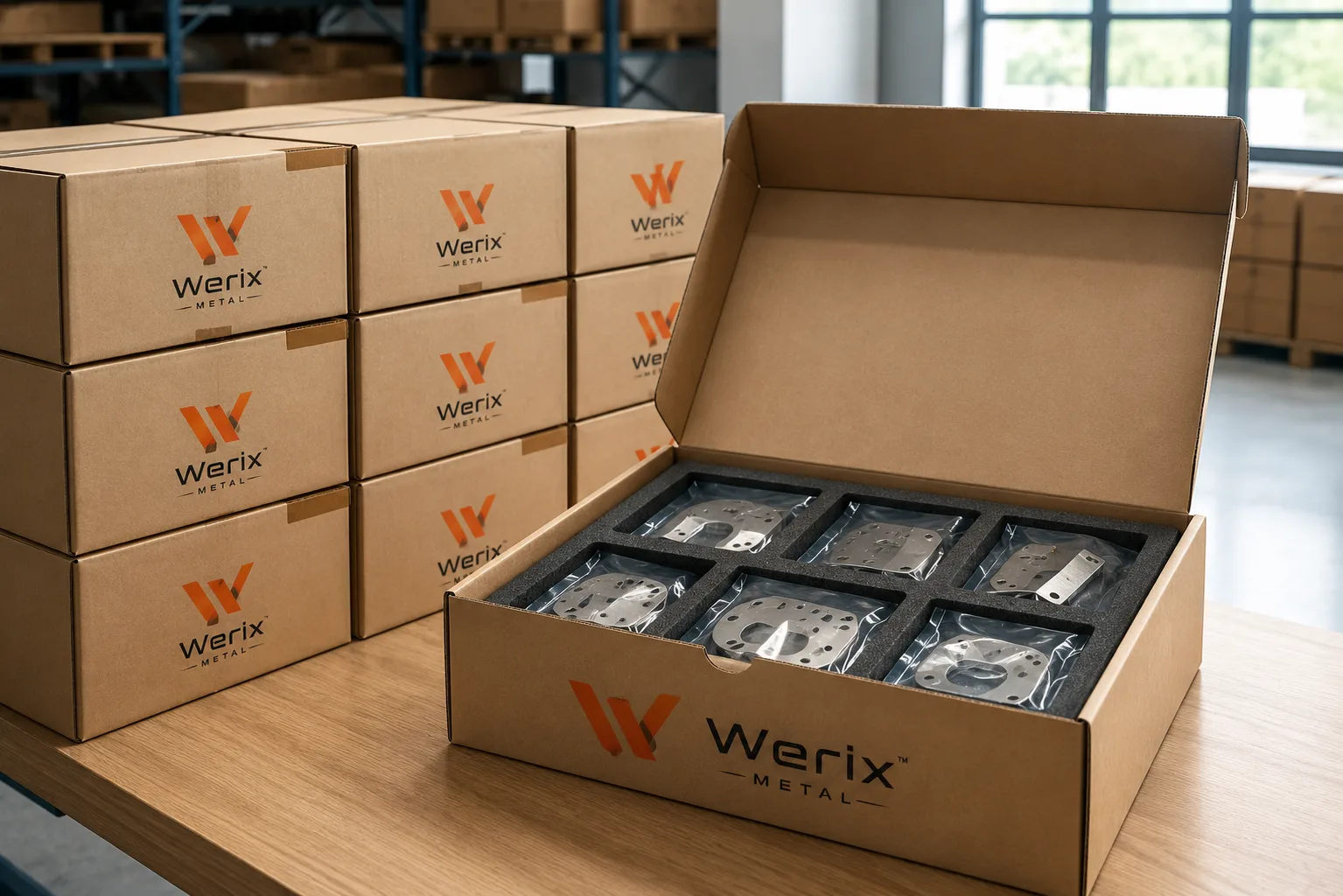
- Stage 4 — Shipment audit: packaging, labeling, surface protection, quantity count, and batch traceability confirmed before dispatch. Packing photos sent to you before shipment.
For large-volume orders or first-time suppliers, consider engaging a third-party inspection service (SGS, Bureau Veritas, TÜV) for pre-shipment inspection. The cost is typically $300–$800 per inspection day — negligible compared to the cost of receiving a container of non-conforming parts. Once trust is established with your supplier, you can transition to the factory's internal QC reports supplemented by periodic third-party audits.
What to Ask Your Supplier About QC
Request: (1) a description of their 4-stage QC process, (2) sample FAI (First Article Inspection) reports from a recent order, (3) calibration records for their CMM and measurement instruments, (4) first-pass yield data (98%+ is excellent for sheet metal), and (5) a sample material certificate from their steel supplier. A quality supplier will provide all five without hesitation.
For large-volume orders or first-time suppliers, consider engaging a third-party inspection service (SGS, Bureau Veritas, TÜV) for pre-shipment inspection. The cost is typically $300–$800 per inspection day — negligible compared to the cost of receiving a container of non-conforming parts. Once trust is established with your supplier, you can transition to the factory's internal QC reports supplemented by periodic third-party audits.
Communication Best Practices
Communication is the most underestimated risk in overseas sourcing. Language barriers, time-zone differences, and cultural norms around directness can lead to misaligned expectations and costly misunderstandings. These practices help bridge the gap effectively.
- Use written communication for all specifications and decisions — verbal agreements are difficult to verify and enforce across languages and time zones
- Provide drawings and specifications in English (and Chinese if possible) — technical terms should be unambiguous; avoid abbreviations that may be interpreted differently
- Set response-time expectations upfront — agree on a maximum response window (e.g., 24 hours for technical questions, 4 hours for urgent production issues)
- Confirm understanding in writing — after a video call or discussion, send a written summary of agreed actions and ask for confirmation; this prevents misinterpretation
- Use structured templates for RFQ submissions — include material, gauge, quantity, finish, tolerance, and destination in every inquiry to eliminate back-and-forth
- Schedule regular video calls for active projects — a 15-minute weekly video call resolves issues faster than 20 email exchanges; seeing the production floor builds trust
- Assign a single point of contact on both sides — multiple contacts create confusion; one engineer on the factory side and one procurement lead on your side keeps communication clear
At WERIX, every project is assigned a single dedicated engineer who speaks English and follows your order from first sample through mass production. This eliminates the relay-style communication common with trading companies and multi-vendor supply chains, where your messages pass through a salesperson before reaching the production floor. Your WERIX engineer walks the same floor where your parts are made — when you ask a technical question, the answer comes from someone who can physically inspect your parts in real time.
At WERIX, every project is assigned a single dedicated engineer who speaks English and follows your order from first sample through mass production. This eliminates the relay-style communication common with trading companies and multi-vendor supply chains, where your messages pass through a salesperson before reaching the production floor. Your WERIX engineer walks the same floor where your parts are made — when you ask a technical question, the answer comes from someone who can physically inspect your parts in real time.
Shipping and Logistics Basics
International shipping from China is well-established, with multiple options for different urgency levels and budget constraints. Understanding the basic Incoterms and shipping modes helps you budget accurately and avoid surprises.
| Incoterm | What It Means | Best For |
|---|---|---|
| EXW (Ex Works) | You arrange all pickup, shipping, customs, and delivery from the factory gate | Buyers with established freight forwarders and customs brokers |
| FOB (Free on Board) | Supplier delivers to the port and loads onto the vessel; you arrange ocean freight, insurance, and destination customs | Most common for sheet metal; balances control and convenience |
| CIF (Cost, Insurance, Freight) | Supplier arranges and pays for shipping and insurance to your destination port; you handle customs and local delivery | Buyers who want the supplier to handle international logistics |
| DDP (Delivered Duty Paid) | Supplier handles everything — shipping, insurance, customs, duties, and delivery to your door | Simplest option for first-time importers; total cost is known upfront |
For shipping modes, ocean freight (LCL or FCL) is the most cost-effective for production volumes — transit time from Guangdong to North America is 20–30 days; to Europe is 25–35 days. Air freight delivers in 3–7 days but costs 5–8× more — use it for urgent prototypes or small shipments under 100 kg. Rail freight to Europe (via the China-Europe rail corridor) takes 15–20 days at roughly 60% of air-freight cost, making it a good middle ground for European buyers.
- Ocean freight (LCL — less than container load): best for shipments 0.5–15 CBM; cost: $80–$150/CBM to North America, $60–$120/CBM to Europe
- Ocean freight (FCL — full container load): best for shipments above 15 CBM; 20ft container holds ~28 CBM, 40ft holds ~58 CBM
- Air freight: $4–$8/kg to North America, $5–$10/kg to Europe; use for urgent prototypes or high-value low-weight parts
- Rail freight to Europe: 15–20 day transit; $2–$4/kg; available from major Chinese rail hubs to European destinations
- Customs and duties: most sheet-metal parts (HS code 7326 or 7616) attract 0–8% duty depending on destination country and trade agreements; verify the specific rate with your customs broker
Budgeting for Total Landed Cost
When comparing a domestic supplier quote to a China quote, always calculate total landed cost: China factory price + international freight + customs duties + local delivery + insurance. For typical sheet-metal shipments via ocean freight to North America, add $0.50–$2.00/part for shipping and $0.10–$0.50/part for duties. Even with these additions, China direct-factory pricing typically remains 20–40% below domestic alternatives for production volumes.
For shipping modes, ocean freight (LCL or FCL) is the most cost-effective for production volumes — transit time from Guangdong to North America is 20–30 days; to Europe is 25–35 days. Air freight delivers in 3–7 days but costs 5–8× more — use it for urgent prototypes or small shipments under 100 kg. Rail freight to Europe (via the China-Europe rail corridor) takes 15–20 days at roughly 60% of air-freight cost, making it a good middle ground for European buyers.
よくある質問
著者
Tom
Senior Process Engineer
板金加工、CNC加工、表面仕上げを専門とする経験豊富な製造エンジニアです。エンジニアがインテリジェントな調達意思決定を行えるよう、実践的なガイドを執筆しています。
プロジェクトを始める準備はできましたか?
24時間以内にDFMフィードバックと見積もりをご提供します。最小注文数量なし。