목차
Why Understanding Sheet Metal Quoting Matters
If you source custom sheet-metal parts, you receive quotes from multiple suppliers — and the numbers rarely match. One supplier quotes $4.80 per part; another quotes $7.20 for the same drawing. The difference is not random — it reflects how each supplier calculates material, processes, finishing, tooling, packaging, and logistics. Understanding these six cost components puts you in control of procurement decisions. Instead of blindly accepting the lowest bid, you can identify where a quote is inflated, where a supplier is cutting corners, and where design changes would reduce cost without affecting function. This guide breaks down each component with real-world numbers, shows how volume affects pricing, and gives you a framework for comparing quotes from different suppliers on equal terms.
The 6 Main Components of a Sheet Metal Quote
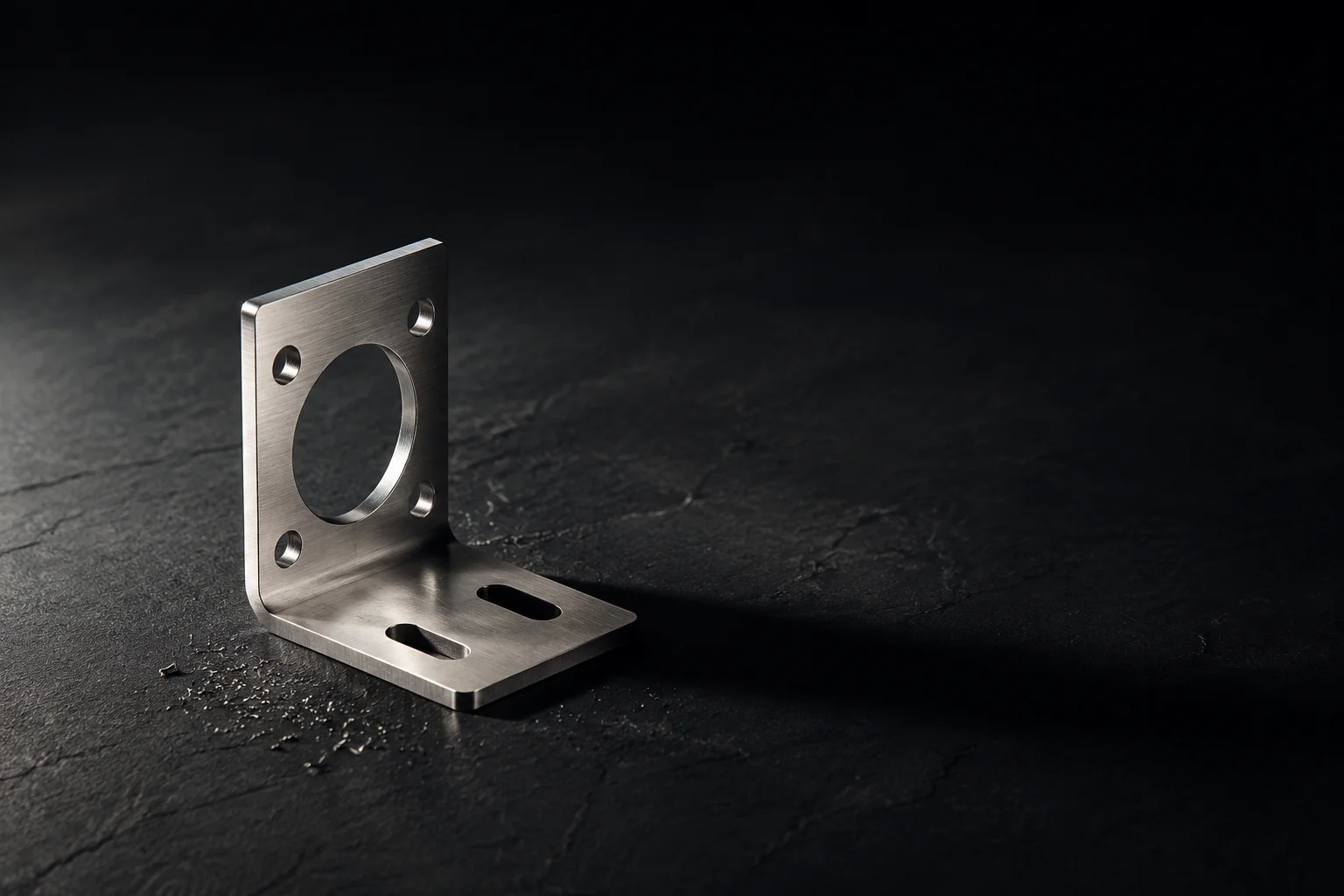
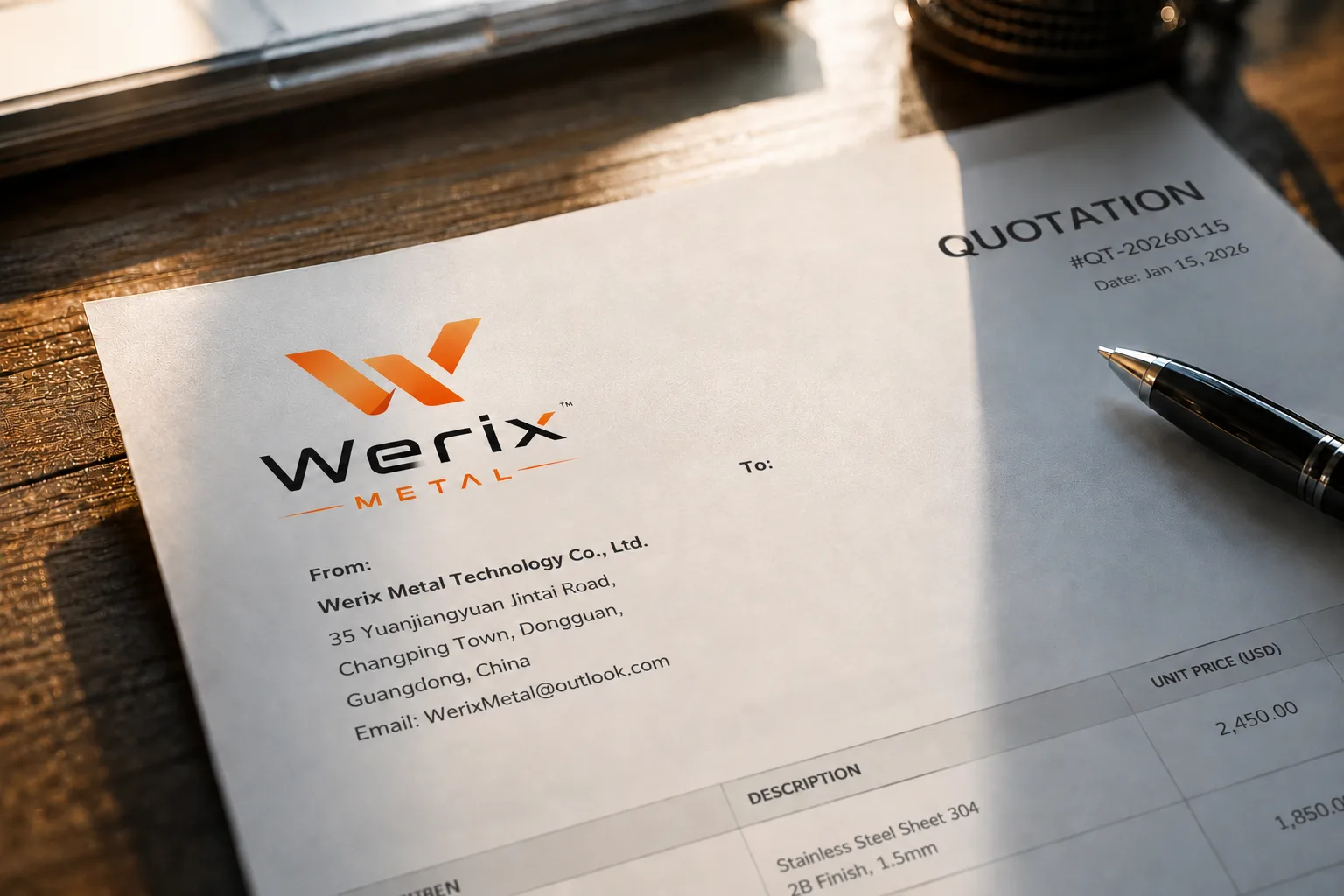
Every sheet metal quote — whether from a small job shop or a large source factory — is built from the same six cost buckets. The proportions shift based on part complexity, volume, and supplier model, but the structure is universal.
- Material cost — the raw sheet stock (steel, aluminum, stainless, copper) required to cut your part, including waste (skeleton) from nesting
- Processing cost — the machine time and labor for each fabrication step: laser cutting, CNC punching, bending, welding, hardware insertion, deburring
- Finishing cost — surface treatments applied after fabrication: powder coating, anodizing, plating, painting, passivation, or bead-blasting
- Tooling cost — non-recurring engineering (NRE) for custom dies, jigs, fixtures, or specialty tooling; applies to stamping, progressive dies, and some bending setups
- Packaging cost — materials and labor for protective packaging: PE foam, cartons, wooden crates, VCI film for corrosion protection, and inner dividers
- Logistics cost — shipping from factory to your dock: freight charges, customs brokerage, insurance, and any applicable duties or taxes
Not Every Quote Shows All Six
Many suppliers lump packaging and logistics into a single "shipping" line, or hide tooling amortization inside the per-part price. When comparing quotes, always ask for an itemized breakdown across all six categories. A quote that appears cheaper on the surface may be hiding tooling amortization or skipping protective packaging.
Typical Cost Breakdown by Percentage
The relative weight of each cost component varies with volume, part complexity, and material choice. The table below shows typical ranges for a mid-complexity sheet-metal bracket (2 bends, 3 holes, powder-coated finish) in cold-rolled steel, based on production data from a source factory in China.
| Cost Component | 1 Piece (Prototype) | 100 Pieces | 1,000 Pieces | 10,000+ Pieces |
|---|---|---|---|---|
| Material | 25–35% | 30–40% | 35–45% | 40–50% |
| Processing (cut, bend, deburr) | 30–40% | 25–35% | 20–30% | 15–25% |
| Finishing (powder coat) | 15–20% | 12–18% | 10–15% | 8–12% |
| Tooling (NRE) | 10–15% | 3–8% | 1–3% | <1% (amortized) |
| Packaging | 3–5% | 3–5% | 2–4% | 2–3% |
| Logistics | 5–10% | 5–8% | 4–7% | 3–5% |
At prototype volumes, processing and tooling dominate because setup time is spread across very few parts. At production volumes, material becomes the largest single cost driver because machine efficiency improves and tooling is amortized across thousands of units. Understanding these shifts helps you focus cost-reduction efforts where they have the most impact at each volume tier.
At prototype volumes, processing and tooling dominate because setup time is spread across very few parts. At production volumes, material becomes the largest single cost driver because machine efficiency improves and tooling is amortized across thousands of units. Understanding these shifts helps you focus cost-reduction efforts where they have the most impact at each volume tier.
What Drives Price Up or Down
Six variables have the greatest impact on your quoted unit price. Small changes in any one of these can shift cost by 15–40%.
| Factor | Low Cost | High Cost | Cost Impact |
|---|---|---|---|
| Material choice | CR steel (SPCC) | SS 316 or copper | 2–6× material cost difference |
| Sheet thickness | 0.8–1.2 mm | 3.0–5.0 mm | 20–50% slower cutting + heavier stock |
| Tolerance tightness | ±0.2 mm general | ±0.05 mm precision | 15–30% processing premium |
| Bend count | 1–2 bends | 6–8 bends | Each bend adds $0.10–$0.50 setup + cycle time |
| Surface finish | No finish (bare) | Mirror polish + clear coat | 15–25% of part cost |
| Part geometry | Simple rectangle | Complex contour with many cutouts | 20–60% more cutting time |
Tolerance specification is the single most overlooked cost driver. In our experience, over 60% of submitted drawings specify precision tolerances on dimensions that are non-functional — switching those to standard tolerances (±0.2 mm linear, ±0.5° angular) immediately reduces cost by 15–30% with zero design changes. If you are unsure which dimensions are critical, ask your fabricator for a DFM review before finalizing the drawing.
The Tolerance Trap
Specifying ±0.05 mm on every dimension when ±0.2 mm is functionally adequate forces the fabricator into slower laser passes, tighter inspection protocols, and higher scrap rates. On a typical 20-dimension part, the difference between all-precision and smart-tolerance can be $1.50–$3.00 per unit at volume. Always differentiate critical functional dimensions from general reference dimensions.
Tolerance specification is the single most overlooked cost driver. In our experience, over 60% of submitted drawings specify precision tolerances on dimensions that are non-functional — switching those to standard tolerances (±0.2 mm linear, ±0.5° angular) immediately reduces cost by 15–30% with zero design changes. If you are unsure which dimensions are critical, ask your fabricator for a DFM review before finalizing the drawing.
How Volume Changes Your Unit Price
Sheet metal pricing is not linear with volume. The per-part price drops steeply from 1 to 100 pieces, then more gradually from 100 to 1,000, and flattens above 1,000 for laser-cut-and-bent parts. For stamped parts, the curve is different: per-part cost drops sharply once volume exceeds the die-amortization threshold (typically 2,000–5,000 pieces for a progressive die costing $3,000–$15,000).
| Quantity | Typical Unit Price (1.5 mm CRS bracket, 2 bends, powder coat) | Cost Driver |
|---|---|---|
| 1 piece | $12.00–$18.00 | Setup + program time dominates; tooling not amortized |
| 10 pieces | $7.00–$10.00 | Setup partially shared; still prototype-level efficiency |
| 100 pieces | $3.50–$5.50 | Setup amortized; batch efficiency in cutting and finishing |
| 1,000 pieces | $2.00–$3.50 | Material + processing optimized; tooling fully amortized |
| 10,000 pieces | $1.40–$2.50 | Bulk material pricing; consider stamping if die cost is justified |
| 50,000+ pieces | $0.90–$1.80 | Progressive stamping becomes most cost-effective; material negotiated at mill level |
The crossover between laser-cut-and-bend and stamping depends on die cost and part complexity. For a simple bracket, stamping breaks even around 2,000–5,000 pieces when die cost ($3,000–$8,000) is amortized. For complex parts with multiple forming operations, the crossover can be 5,000–10,000 pieces. Always ask your supplier for a cost crossover analysis at quoting stage — the answer may surprise you.
The crossover between laser-cut-and-bend and stamping depends on die cost and part complexity. For a simple bracket, stamping breaks even around 2,000–5,000 pieces when die cost ($3,000–$8,000) is amortized. For complex parts with multiple forming operations, the crossover can be 5,000–10,000 pieces. Always ask your supplier for a cost crossover analysis at quoting stage — the answer may surprise you.
How to Reduce Your Quote Without Sacrificing Quality
The most effective cost-reduction strategies are free — they require only a review of your design and specifications, not redesign. Here are the actions that deliver the largest savings with the least effort.
- Relax non-critical tolerances: review every ±0.05 mm callout — if the dimension is not a mating interface or alignment feature, switch to ±0.2 mm. Typical savings: 15–30%.
- Use standard gauges: specify 0.8, 1.0, 1.2, 1.5, 2.0, or 2.5 mm — non-standard gauges carry mill surcharges of 10–20%.
- Downgrade material where possible: 304 stainless instead of 316 saves 15–20%; CR steel instead of stainless for indoor applications saves 60–70%.
- Reduce bend count: every bend beyond the first adds setup time and cycle time. Ask whether the same function can be achieved with fewer bends — each removed bend saves $0.10–$0.50 per part.
- Consolidate parts: replacing 3 separate brackets with 1 formed bracket saves 2× setup, 2× finishing, and assembly labor. Savings: 30–60%.
- Optimize nesting: ask your fabricator for a nesting analysis — tightly nested parts can save 5–15% on material utilization.
- Increase order volume: batching orders from weekly to monthly runs can save 10–20% by reducing setup frequency.
Start With Zero-Change Savings
Tolerance review, gauge standardization, and alloy downgrade require zero design changes — just a review of your current specifications. These three actions alone typically save 20–35% on part cost. Part consolidation requires redesign but delivers the largest absolute savings on assemblies.
How to Read and Compare Quotes From Different Suppliers
Comparing quotes from different suppliers is only valid when the scope is identical. Two quotes for the "same" part can differ by 30% because one includes powder coating and the other does not, or one quotes DDP and the other quotes EXW. Before comparing unit prices, align on these dimensions:
| Checklist Item | What to Verify | Why It Matters |
|---|---|---|
| Material grade & gauge | Same UNS/EN number, same thickness (not just "stainless") | Grade 430 vs. 304 is a 30% price difference |
| Finish specification | Same coating type, thickness, and color standard (RAL/Pantone) | Powder coat can range from $0.50 to $3.00/part depending on spec |
| Tolerance block | Same general and critical tolerances on both quotes | Over-tolerancing inflates processing cost 15–30% |
| Incoterms | EXW, FOB, DDP, or DAP — must match | DDP includes duties + delivery; EXW excludes all shipping |
| Tooling treatment | NRE shown separately or amortized into unit price? | Amortized tooling looks cheaper per-part but is hidden |
| Packaging spec | Standard carton or custom packaging? | Custom packaging can add $0.30–$2.00/part |
| QC documentation | FAI report, material cert, dimensional report included? | Some suppliers charge separately for documentation |
A useful exercise is to request itemized breakdowns from each supplier, then normalize the quotes to the same Incoterms, finish spec, and tolerance block. If after normalization the quotes are within 10%, the remaining difference likely reflects genuine operational efficiency. If the gap is 20% or more after normalization, something is materially different — ask for clarification before choosing the lowest bid.
The Lowest Quote Is Not Always the Cheapest
A quote that is 15% below the normalized average often signals a supplier cutting corners — cheaper material, skipped inspection steps, inadequate packaging, or thinner-than-specified coating. These savings disappear when parts fail incoming inspection or corrode in the field. Always verify that the scope matches your requirements before awarding on price.
A useful exercise is to request itemized breakdowns from each supplier, then normalize the quotes to the same Incoterms, finish spec, and tolerance block. If after normalization the quotes are within 10%, the remaining difference likely reflects genuine operational efficiency. If the gap is 20% or more after normalization, something is materially different — ask for clarification before choosing the lowest bid.
Quote Timeline and Process
The time from file upload to final quote depends on the supplier's quoting infrastructure and part complexity. Modern source factories with AI-assisted quoting can return pricing within 24 hours for standard parts; complex assemblies with multiple sub-processes may take 2–3 days for engineer-validated pricing.
| Stage | Typical Duration | Deliverable |
|---|---|---|
| File upload & AI analysis | Minutes to hours | Automated geometry analysis and cost estimate |
| Engineer DFM review | 4–12 hours | DFM flags, feasibility confirmation, cost-down suggestions |
| Final quote delivery | Within 24 hours (standard) | Itemized PDF with pricing, lead time, and DFM notes |
| Quote revision | Same day to 24 hours | Updated pricing reflecting DFM changes or scope adjustments |
| Quote validity | Typically 15–30 days | Fixed pricing window; material-price escalation clauses may apply after expiry |
To get the fastest and most accurate quote, provide complete information upfront: 3D CAD file (STEP preferred), material grade and gauge, quantity, finish specification, tolerance requirements, and delivery destination. Incomplete submissions require back-and-forth that adds 1–2 days to the timeline. At WERIX, our AI-powered quotation system analyzes geometry against a knowledge base of 11 years of production data — laser cutting speeds, bend cycle times, material costs, and setup patterns — to generate pricing calibrated to our actual equipment within hours. A senior engineer then reviews every quote for DFM feasibility, material availability, and project-specific adjustments before the final pricing is delivered.
To get the fastest and most accurate quote, provide complete information upfront: 3D CAD file (STEP preferred), material grade and gauge, quantity, finish specification, tolerance requirements, and delivery destination. Incomplete submissions require back-and-forth that adds 1–2 days to the timeline. At WERIX, our AI-powered quotation system analyzes geometry against a knowledge base of 11 years of production data — laser cutting speeds, bend cycle times, material costs, and setup patterns — to generate pricing calibrated to our actual equipment within hours. A senior engineer then reviews every quote for DFM feasibility, material availability, and project-specific adjustments before the final pricing is delivered.
자주 묻는 질문
작성자
Tom
Senior Process Engineer
금속판 가공, CNC 가공 및 표면 마감을 전문으로 하는 풍부한 경험을 가진 제조 엔지니어입니다. 엔지니어들이 정보에 입각한 조달 결정을 내릴 수 있도록 실용적인 가이드를 작성합니다.
프로젝트를 시작할 준비가 되셨나요?
24시간 이내에 DFM 피드백과 견적을 받아보세요. 최소 주문 수량 없음.